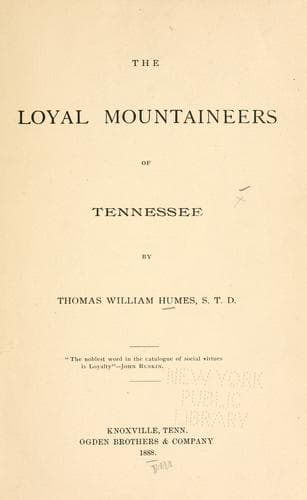
The loyal mountaineers of TennesseeHumes, Thomas William
Philosophy
The loyal mountaineers of Tennessee
Humes, Thomas William
Tennessee, East -- History -- Civil War, 1861-1865
Gen. Carter says in conclusion, that “notwithstanding the inclemency
of the weather, the severity of the march and the scanty supply of
rations, for no inconsiderable portion of the time; both officers
and men bore their hardships without a single murmur or word of
complaint. They returned after a journey of 470 miles, 170 of which
were in the enemy’s country, in high spirits and in good condition,
proud to think they had accomplished a feat which for hazard and
hardship has no parallel in the history of the war.”
APPENDIX: NOTE N: Page 196.
When the United States Army under Burnside approached Knoxville,
September, 1863, Captain S. T. Harris was taken with other prisoners
to Columbia, S. C. He was there put in chains that weighed from 12 to
15 pounds, and cruelly imprisoned. His father applied to President
Davis, and in consequence, he was transferred from the filthy and
almost airless cell where he lay, to a better one.
In the same prison were confined a scaling party of the United States
Naval Officers, who had been captured in a night attack on Fort
Sumter, September, 1863. One of them was Ensign Porter, of whom the
Rev. H. Clay Trumbull says in the Church Magazine, August, 1886;
“Apart of the time he was in irons as one of the hostages for two
Confederate privateersmen who were held by our (the United States)
Government as pirates. He was the life of the party. He was always
taking a cheery view of the situation.... In a room of the jail,
adjoining that of the naval officers, there was confined in irons a
Captain Harris of Tennessee, held as a hostage for some Confederate
prisoner under special charges. It was a delight of Ben. Porter to
put his mouth to the key-hole of the intervening door and whistle a
lively tune, while the Captain danced to it with the accompanying
clanking of his chains. After Porter had been himself in irons,
he taught Captain Harris how to remove and replace his handcuffs
and fetters, without the knowledge of the prison officials. It was
through this instruction, that Captain Harris’s life was saved when
the Columbia jail was burned, early in 1865.”
Public-domain text, read in full here on John Shaqi.
Reviews
Reviews
No reviews yet
Be the first to share your thoughts on this work.
Elsewhere in the archive
Join the Discussion
Join the discussion
Sign in to leave a comment or review.
Sign InorCreate an account