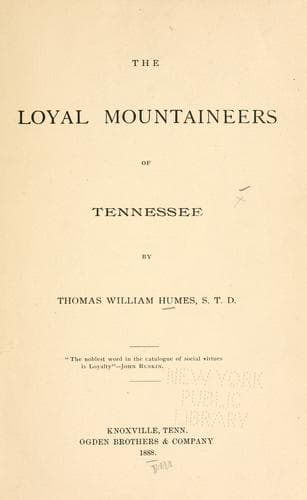
The loyal mountaineers of TennesseeHumes, Thomas William
Philosophy
The loyal mountaineers of Tennessee
Humes, Thomas William
Tennessee, East -- History -- Civil War, 1861-1865
The next day, changing the direction of retreat, he went a few miles,
watched all night for an attack, then marched twenty miles and
halted forty-eight hours, with only thirty-five miles between him
and Cornwallis. In a dispatch to that General, he spoke of his enemy
as “of some consequence” by reinforcements, and of his hopefulness,
yet doubt, of success. “Three or four hundred good soldiers--part
dragoons,” he said, “would finish the business. Something must be
done soon.” Sixteen miles more of travel brought him to King’s
Mountain, a ridge sixty feet high, six hundred yards long by
two hundred and fifty wide at its base, and from sixty to one
hundred yards wide on top. Upon it he encamped, October the sixth.
Without fortifying the position, he expressed entire confidence in
maintaining it. Several Whig leaders in their narratives attribute
sayings to him on the subject that are boastful and blasphemous.
CHAPTER II.
EARLY HISTORY--THE PURSUIT--THE BATTLE--THE VICTORY.
“Hark to the trump and the drum,
And the mournful sound of the barbarous horn,
And the flap of the banners that flit as they’re borne,
And the neigh of the steed, and the multitude’s hum,
And the clash, and the shout, ‘They come! they come!’”
LORD BYRON.
Ferguson’s foes heard, on October 4, of his retreat, but were
doubtful of its direction. Following his footsteps, they made little
progress that day, for men and horses were weary. Maj. Candler, with
thirty of Clarke’s refugees from Georgia, joined them; also, in the
march on the 5th, Maj. Chronicle, with twenty men from the Catawba
River. Col. Lacey arrived that night at their camp on Green River,
from an encampment of four hundred and thirty Whigs, in Rutherford
County, two hundred and seventy of whom were South Carolinians
under Colonels Lacey and Hill, and one hundred and sixty were North
Carolinians--one hundred commanded by Col. Williams, and sixty by
Colonels Graham and Hambright. Lacey gave the mountaineers definite
information concerning Ferguson, and it was agreed that they and the
forces Lacey represented should meet at the Cowpens and combine.
The same night, about seven hundred of the troops commanded by Col.
Campbell and his compatriots, whose horses were in condition for
rapid movement were selected, and on the next day they marched to the
Cowpens, leaving seven hundred men under command of Maj. Herndon to
follow more slowly.
Public-domain text, read in full here on John Shaqi.
Reviews
Reviews
No reviews yet
Be the first to share your thoughts on this work.
Join the Discussion
Join the discussion
Sign in to leave a comment or review.
Sign InorCreate an account