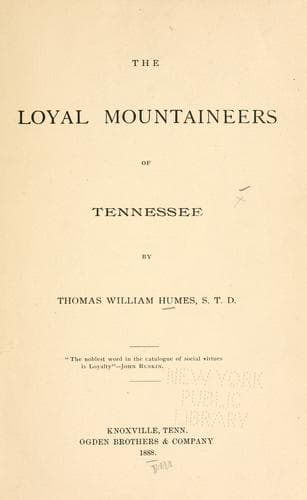
The loyal mountaineers of TennesseeHumes, Thomas William
Philosophy
The loyal mountaineers of Tennessee
Humes, Thomas William
Tennessee, East -- History -- Civil War, 1861-1865
At the Cowpens, a junction of forces as pre-arranged was made. The
four hundred and thirty soldiers commanded by Lacey and others, were
reduced by selection to two hundred and ten. These made the whole
body of chosen cavalry, nine hundred and ten. At 9 P. M. October
6, they started and rode all night in a drizzling rain to overtake
Ferguson, whose army, as a spy informed them, numbered fifteen
hundred men. With the return of daylight, they made better speed,
but still the rain fell and they could scarcely keep their guns dry.
They forded the deep waters of Broad River at sunrise, halted a few
minutes to breakfast from the scanty food they carried, and would
have halted at noon, because of the stormy weather and their fatigue.
Campbell, Sevier and Cleveland proposed to do so, but Shelby, with
profane words, refused. He would brook no delay until night fell or
Ferguson was found. A scout who had visited a Tory family, disguised
as “a true King’s man,” brought them word that the British army
was posted on King’s Mountain. When within a few miles of it, they
captured from a courier a dispatch sent by Ferguson to Cornwallis,
calling for help by reinforcement and declaring his purpose against
the rebels in very uncourteous and profane language. It was told to
the American troops, and only quickened their speed. With galloping
horses they went forward in sight of the enemy’s camp.
It was early in the afternoon of the seventh of October, 1780. The
rain had ceased and the clouds were rolling away before the bright
shining of the sun. This was auspicious. These plain men from west of
the Alleghanies may not have understood how critical was that hour
of the American Revolution, even as well as did the harried Whigs
from the Carolinas who were their companions in arms; but they were
wide awake to the value of the rights for which their countrymen
contended, and of the opportunity at hand to help them. Not one of
those who were about to go into battle for the Colonies saw, as the
men of to-day can see, along with the greatness of the danger to the
struggle for American independence, the important consequences of
their own heroic conduct. Men engaged in war are intent upon present
deeds rather than thoughtful of future results.
Public-domain text, read in full here on John Shaqi.
Reviews
Reviews
No reviews yet
Be the first to share your thoughts on this work.
Join the Discussion
Join the discussion
Sign in to leave a comment or review.
Sign InorCreate an account