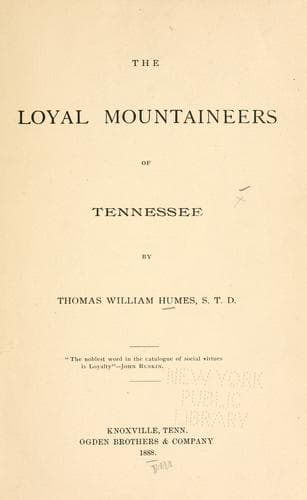
The loyal mountaineers of TennesseeHumes, Thomas William
Philosophy
The loyal mountaineers of Tennessee
Humes, Thomas William
Tennessee, East -- History -- Civil War, 1861-1865
The inchoate State gave due attention to its relations with the
Indians, and conducted all its affairs without serious difficulty
until near the close of the year 1785. Before that time an attempt
was made in Washington County, Virginia, to use the privilege
accorded to its citizens by the original Association of western
counties, to join the new Commonwealth, but the movement was
speedily prevented by Patrick Henry, then Governor of Virginia. The
Convention of Frankland appointed to be held in November 1785, met
at Greeneville in that month, adopted a Constitution like that of
North Carolina, and sent a memorial to Congress by William Cocke,
Esq., which was fruitless. Five days later the Legislature of North
Carolina convened and passed an Act declarative of its desire
“to extend the blessings of civil government to citizens of the
western counties until such time as they might be separated with
advantage and convenience to themselves,” and “to hear and redress
their grievances.” It offered amnesty to all persons concerned in
establishing the State of Frankland who should renew their allegiance
to the State of North Carolina. It provided for an election of
members of the General Assembly next succeeding, to be held in the
revolted counties, and also appointed civil and military officers
for those counties, who should supersede like officers of the
State of Frankland. Ever since the repeal by North Carolina of the
Act ceding its western lands to the United States, there had been
opposition to the new State among its citizens. The two parties were
now brought into closer antagonism. Under the authority of both rival
governments, courts were held in the same counties, different laws
were enforced, taxes levied and the militia called into service. Of
course it followed that mutual animosities grew more intense, and
practical collisions were frequent. On several occasions armed men
of the respective parties visited rooms where courts were held by
their adversaries; violent seizures were made of public records,
and officers of the courts turned out of doors. In one instance the
papers of a Frankland clerk having been forcibly abducted by partisan
friends of the parent State, they were afterwards recaptured, and
their official owner, to secure their future safety, hid them in a
cave. These spoliations on both sides were more or less disastrous to
litigants and owners of real estate. They also excited contentious
followers of the two governments beyond self-control, and their
exasperated feelings found vent at public meetings in pugilistic
encounters. The combatants did not so far forget that they were
neighbors, as do men at this period of more advanced civilization,
and resort to the use of deadly weapons. They contented themselves
with fisticuffs as means of drawing blood.
Public-domain text, read in full here on John Shaqi.
Reviews
Reviews
No reviews yet
Be the first to share your thoughts on this work.
Join the Discussion
Join the discussion
Sign in to leave a comment or review.
Sign InorCreate an account