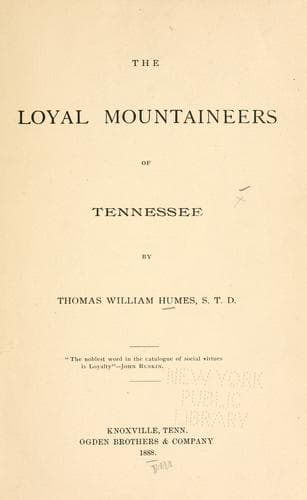
The loyal mountaineers of TennesseeHumes, Thomas William
Philosophy
The loyal mountaineers of Tennessee
Humes, Thomas William
Tennessee, East -- History -- Civil War, 1861-1865
The State of Frankland, although weakened by defections of its former
friends at home, still stood with unbroken frame, but over it hung
portentous signs of more deadly strife among its citizens and of
disaster to itself that might be fatal. In view of them, all aid and
support that could properly be had, were important to it. As early
as 1784, at Gov. Sevier’s suggestion, the General Assembly had, by
a competent diplomatic agent, expressed to the Governor of Georgia,
its willingness to unite with that State in a war which threatened
to become necessary against the Creek Indians. The Legislature of
Georgia gave respectful consideration to the letters, and friendly
communications were interchanged in 1787; but the Governor of
Georgia, while acknowledging gratefully the readiness of the
Frankland government to co-operate as desired, was prudent to limit
his assurances of reciprocal service to his power, and to consistency
with the interests of the State of Georgia and its paramount duty to
the United States. Less reserve of sentiment was shown by prominent
citizens of Georgia. They spoke in warm praise of the zeal for
liberty manifested by the Franks, and of the independent State they
had organized. Sevier was addressed by letter as its Governor, and
in social circles men drank “success to the State of Frankland, His
Excellency, Governor Sevier and his virtuous citizens.”
Dr. Benjamin Franklin had a wide reputation for great wisdom
concerning public affairs, and Gov. Sevier wrote to him for advice
as to the new State. He replied from Philadelphia, June 30, 1787,
acknowledging the honor done him by “His Excellency and Council.”
“There are two things,” he said, “which humanity induces me to wish
you may succeed in: the accommodating your misunderstanding with
the government of North Carolina, and the avoiding an Indian war by
preventing encroachments on their lands. Such encroachments are the
more unjustifiable, as these people in the fair way of purchase,
usually give very good bargains, and in one year’s war with them
you may suffer a loss of property and be put to an expense vastly
exceeding in value what would have contented them perfectly in
fairly buying the lands they can spare.... I have no doubt of the
good disposition of your government to prevent their receiving such
injuries; but I know the strongest governments are hardly able to
restrain the disorderly people who are generally on the frontiers,
from excesses of various kinds, and possibly yours has not as yet
acquired sufficient strength for that purpose. It may be well,
however, to acquaint those encroachers that the Congress will not
justify them in the breach of a solemn treaty; and that if they bring
upon themselves an Indian war, they will not be supported in it. I
will endeavor to inform myself more perfectly of your affairs by
enquiry and searching the records of Congress; and if anything should
occur to me that I think may be useful to you, you shall hear from me
thereupon.
Public-domain text, read in full here on John Shaqi.
Reviews
Reviews
No reviews yet
Be the first to share your thoughts on this work.
Join the Discussion
Join the discussion
Sign in to leave a comment or review.
Sign InorCreate an account