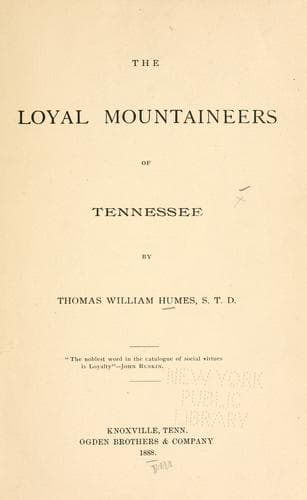
The loyal mountaineers of TennesseeHumes, Thomas William
Philosophy
The loyal mountaineers of Tennessee
Humes, Thomas William
Tennessee, East -- History -- Civil War, 1861-1865
“I conclude with repeating my wish that you may amicably settle your
difficulty with North Carolina. The inconvenience to your people
of attending so remote a seat of government, and the difficulty to
that government in ruling well so remote a people, would, I think,
be powerful inducements to it to accede to any fair and reasonable
propositions it may receive from you, if the Cession Act had now
passed.”
The course of events in the last months of 1787 moved rapidly towards
their definite conclusion. John Sevier was still addressed in letters
by Dr. Franklin and the Governor of Georgia as Governor of Frankland.
While the eminent, philanthropic statesman persuaded to a policy of
peace,--the fruit of fair dealing with the Indians; the Legislature
of Georgia passed an Act to levy three thousand of its own citizens
for war with the Creeks as irreconcilable enemies, and Gov. Mathews
sent a copy of that Act to Gov. Sevier with the request for fifteen
hundred men from Frankland to assist in the campaign. Gov. Sevier
yielded to this solicitation, and about the end of the year gave
orders for arraying his militia.
Meanwhile the rival Governments proceeded with their respective
affairs in the disputed territory. The Legislature of Frankland
met at Greeneville in September, 1787. It appointed two prominent
citizens to represent it before the North Carolina General Assembly,
to which members were elected from all the western counties. That
Assembly met in November, offered anew to all who had departed from
their allegiance full pardon and restoration to citizenship, and
passed other lenient measures relating to non-compliance with the
State revenue laws and delay in reporting taxable property. A proof
of the waning fortunes of Frankland was given in the acceptance of
a Superior Court Judgeship for the West by David Campbell under an
appointment from the North Carolina Legislature at that session.
He had been a member of the Convention of 1784 that led to the
formation of the new State, and of the Convention in 1785 to frame
a Constitution, and had also been a Judge of its Superior Court by
election of the Legislature in 1785: and his consent to serve its
adversary at such a juncture, though it brought upon him severe
reproach for desertion, in one instance directly from Gen. White, a
fast friend of Frankland, nevertheless tended to convince some that
he had left “a sinking ship.”
Public-domain text, read in full here on John Shaqi.
Reviews
Reviews
No reviews yet
Be the first to share your thoughts on this work.
Join the Discussion
Join the discussion
Sign in to leave a comment or review.
Sign InorCreate an account