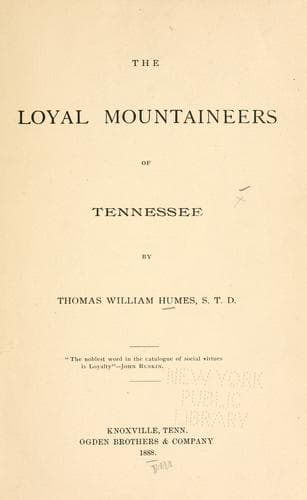
The loyal mountaineers of TennesseeHumes, Thomas William
Philosophy
The loyal mountaineers of Tennessee
Humes, Thomas William
Tennessee, East -- History -- Civil War, 1861-1865
At the same time the internal dissension drew near its crisis. Late
in the year 1787, a writ of _fieri facias_ had been issued, and early
in 1788, the sheriff, under authority of North Carolina, executed it
against the estate of Gov. Sevier; visited his farm on the Nolachucky
River, carried off his negroes and lodged them securely at the house
of his principal foe, Col. John Tipton. Sevier, at the time, was
absent from home and near Greene County, providing for defence of
the people against a threatened attack by Indians. Hearing of the
sheriff’s procedure, he at once rallied to him one hundred and fifty
men from the Counties of Greene and Sevier and what is now Blount
County, and went with them to the house of Tipton, against whom the
fuel of his wrath had but a short time before been freshly kindled
by his adversary’s attempt, foiled by Sevier’s absence, to seize his
person. Tipton had but fifteen men in his dwelling when the Governor
arrived with his militia and a small piece of artillery. It was in
the afternoon. Sevier demanded an unconditional surrender, and was
answered defiantly, with an expletive. The oral summons to yield was
then followed by one in writing. To it Tipton made no reply, but sent
it to Col. Maxwell of Sullivan County, with a call for help. Several
days passed, but Sevier forbore to make an assault. Messengers
successfully escaped from the house to gather recruits, some of whom
afterwards made their way into it. The third night a reinforcement
of one hundred and eighty men under Col. Maxwell arrived, awaited
the break of day and then approached the beleaguered dwelling
simultaneously with an attack upon its defenders by the Governor. The
recruits fired their guns and dashed forward with a ringing shout
that was answered by another from the besieged, and followed by a
sally. The united forces triumphed. Sevier’s men were thrown into a
panic and fled. Some of them and their one unused piece of artillery
were captured. Among the prisoners were two of Sevier’s sons, whom
two brothers Webb would have killed in revenge for the death of their
brother in the fight, but Tipton prevented them. According to a more
dramatic account, Tipton himself was determined to hang the two
youths, but was dissuaded by friends, who drew an imaginary picture
of his own sons as captives and about to be slain in enmity to their
father. He was melted to tears, and with strong self-reproach for his
weakness, gave the young men their liberty. Indeed the two parties
appear to have been animated throughout the affair by a spirit not
altogether unneighborly. Sevier, from the beginning of the troubles,
had been disposed to moderation. He sought on this occasion the
recovery of his slaves, but delayed, although urged by others, to
make an assault. Many of the men on both sides were unarmed, and some
having weapons did not load them, or loading them, fired into the
air. One of them said: “We did not go there to fight. The men did
not try to hit anybody.
Public-domain text, read in full here on John Shaqi.
Reviews
Reviews
No reviews yet
Be the first to share your thoughts on this work.
Join the Discussion
Join the discussion
Sign in to leave a comment or review.
Sign InorCreate an account