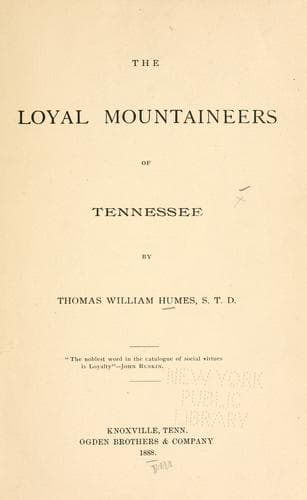
The loyal mountaineers of TennesseeHumes, Thomas William
Philosophy
The loyal mountaineers of Tennessee
Humes, Thomas William
Tennessee, East -- History -- Civil War, 1861-1865
Their visit was soon succeeded by one of more formidable proportions
from indignant citizens, with a local office-holder of the United
States at their head. The suspected political “incendiary” was
arrested and led a prisoner to the court-house. There excited people
gathered, until the room was filled to its utmost capacity. Nor could
this fact justly occasion surprise. Slaves bore the fatal stigma in
public estimation, generally, of being not _persons_, but _things_.
Their classification therefore, in common with houses, goods and
whatever else could, like them, be bought and sold, was under the
head of property. And any alarm raised that peaceful possession of
them was endangered, naturally enough assembled a crowd. A citizen,
attracted to the meeting by its understood object, entered the
court-room, as Parson Brownlow in concluding a speech, gave no
opinion _pro_ or _con_ about the stranger, but advised the people to
watch, for that fomenters of trouble with the negroes were abroad in
the country.
Afterwards, the committee of citizens appointed to consider and
determine the extent of grievance inflicted upon the community and
what should be its redress, reported through its chairman,--who
had led in making the arrest,--that the stranger was guilty of
Abolitionism and should be ordered to leave the town which his
presence put in danger. But further proceedings in the direct line
of a vote upon the proposition, were halted by the courageous
interposition of the Deaf Mutes’ Asylum Principal in behalf of the
prisoner, with whom he had conversed, and who, he averred, was not an
extreme and dangerous anti-slavery man. This reduction of the guilt
of the accused, was promptly and hotly resented by the committee’s
chairman as a denial of his personal veracity, not to be borne. The
Principal, without disputing the logical sequence of that deduction,
stoutly maintained the truth of his statement, and an altercation
ensued that threatened to end in a general row. The assembly became
tumultuous. Men ready for fight with sticks and pistols sprang upon
the platform, where stood the disputants, between whom a third
person, urged on by others, had interposed himself and essayed
to speak. But he could not be heard because of the great clamor,
accompanied by violent gesticulations, of the assembly. At length a
few words from the _tertium quid_, minimizing the difficulty into a
mere difference of opinion between two gentlemen, were listened to,
and the excitement subsided.
As for the troubled Ohioan, he “stood not upon the order of his
going” from a locality inhospitable and dangerous to strangers who
felt free to say that they did not find their Bibles and human
slavery altogether harmonious. It is to this day, however, an
unsolved question, whether as he went, righteous indignation at the
treatment he had received or sincere joy at his escape from worse
ills, prevailed in his soul.
Public-domain text, read in full here on John Shaqi.
Reviews
Reviews
No reviews yet
Be the first to share your thoughts on this work.
Join the Discussion
Join the discussion
Sign in to leave a comment or review.
Sign InorCreate an account