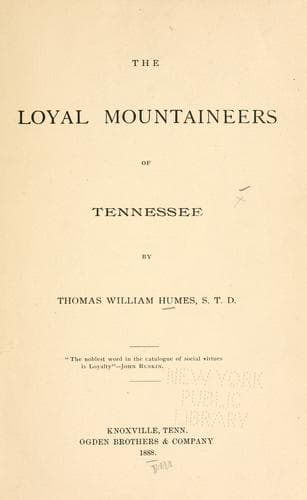
The loyal mountaineers of TennesseeHumes, Thomas William
Philosophy
The loyal mountaineers of Tennessee
Humes, Thomas William
Tennessee, East -- History -- Civil War, 1861-1865
Tennessee was unwilling to depart from her wise sisters in the Union
and join the others in committing what one of her adopted sons,--a
General of the Confederate army,--said to his friend after the
war had ended, “was one of the greatest blunders in history.” The
Legislature of the State proposed a convention to decide what the
State should do concerning its national relations. Governor Isham
G. Harris and his sympathizers, no doubt considered the secession
of Tennessee could be most conveniently accomplished through that
instrumentality: and it was ordered that the question of holding such
a convention should be determined by the people at the ballot-box,
February 9, 1861.
[Illustration: HON. T. A. R. NELSON.]
Love for the Union had not yet weakened in many persons throughout
the State, who at later points of time could not withstand the
accumulated force of motives to give it up,--some of whom in finally
surrendering it, hushed their lingering objections with the plea of
necessity. The majority of people were used to think of the Union
as a precious heritage from their ancestors, and they were unable
to see that they ought to throw that inheritance away, because the
Republican candidate for Chief Magistrate of the Nation had been
elected. Even at the city of Memphis an enlightened public sentiment
in favor of maintaining the Union widely existed in the fall of
1860, and found expression at a large public meeting, called and
participated in by more than a few of the best citizens. Before the
February election the question of secession was often discussed,
not only by politicians before assemblies, but by citizens in
conversation. While enthusiastic disputants threw arguments thick and
fast without convincing one another, they still parted in friendship,
that was sometimes abated by the controversy. The time had not then
come for the wrathfulness of the political atmosphere and excitement
of men’s passions, to prevent colloquial and peaceful interchange
of opinions. As a general rule, secessionists and the disaffected
towards the newly-chosen Government at Washington, were more numerous
in East Tennessee among the rich and persons of best social position,
and were greatly out-numbered among the middle and poorer classes.
Public-domain text, read in full here on John Shaqi.
Reviews
Reviews
No reviews yet
Be the first to share your thoughts on this work.
Join the Discussion
Join the discussion
Sign in to leave a comment or review.
Sign InorCreate an account