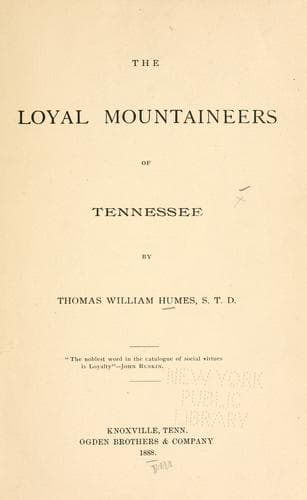
The loyal mountaineers of TennesseeHumes, Thomas William
Philosophy
The loyal mountaineers of Tennessee
Humes, Thomas William
Tennessee, East -- History -- Civil War, 1861-1865
The election in February resulted in a majority of more than sixty
thousand voters for Tennessee continuing in the United States, and
also in a decided majority against holding the proposed convention.
It was clearly to be seen that the people were content to continue in
old and tried paths, and did not think it wise or expedient even to
send delegates of their own choosing to discuss the vital questions
that agitated and threatened the country. Many of them looked upon
the convention with apprehension as a contrivance for mischief. What
if the enemies of the United States intended and should use it as a
hot-bed to mature an ordinance of secession, which, like the gourd
over the head of the displeased and murmuring Hebrew prophet at
Nineveh, quickly grown, would quickly perish? Has not experience any
lesson to teach on the subject of unusual gatherings of inflammable
materials, which a spark may kindle into a great fire, when the air
is very dry from intense heats?
With the advent of spring, in 1861, the muttering of the storm
gathering in the national heavens became louder and longer. The
inauguration of Mr. Lincoln on the fourth of March, was affirmed
by men in Tennessee with others in the South, who were bent upon
separation, to be an ample reason in itself for a dissolution of
the Union. His words when he took the oath of office,--so full of
friendship and good will to the South, fell idly on their ears, and
his abstinence from any act to disturb its peace, did not abate their
hostility a fraction.
During the month of March a young New Yorker arrived at Knoxville,
returning home from Havana, where he had dwelt in the winter for the
sake of health. He found New Orleans, through which his journey lay,
all in a ferment over the cauldron of political troubles in the land.
Not being versed in State-craft nor fully impressed by the gravity of
the national situation, he was disposed to look with a lenient eye
upon the insubordination to the Federal Government prevailing in the
Queen City of the South. Louisiana desired to have a government of
its own, and with great generosity, he said it might be well to let
its people make the experiment. He, at least, was not inclined to
coerce them into obedience. Now and then in his leisure at Knoxville,
as the times were ominous, he kept on the alert for news. One day,
being told of the fall of Fort Sumter, he inquired of an ardent
secessionist standing near:
“Was the attack upon the Fort without provocation?”
The citizen addressed, took the question, not as it was intended,
merely to learn how the fight began, but as a provocation. At once
he spoke with stern manner and strong words of Southern rights and
as his sectional zeal grew more fervid with its venting, he asserted
that “one Southern man could whip five or six Yankees.” He himself
“could whip three or four.”
“My friend,” was the reply, “you are mistaken. We are all of one
Anglo-Saxon blood and Northern men can fight, as well as Southern.”
Public-domain text, read in full here on John Shaqi.
Reviews
Reviews
No reviews yet
Be the first to share your thoughts on this work.
Join the Discussion
Join the discussion
Sign in to leave a comment or review.
Sign InorCreate an account