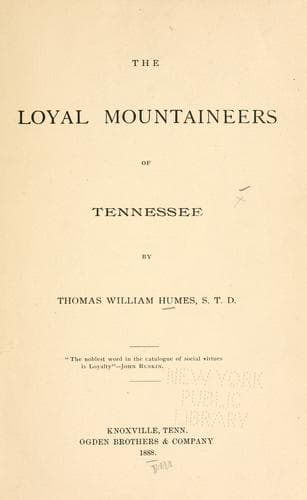
The loyal mountaineers of TennesseeHumes, Thomas William
Philosophy
The loyal mountaineers of Tennessee
Humes, Thomas William
Tennessee, East -- History -- Civil War, 1861-1865
A few hot-bloods not far off, overheard the conversation. One of
them told his companions he knew the stranger by his peculiar speech
to be a Yankee, whom the party at once talked of subjecting to the
indignity of “a ride on a rail.” He caught enough of their words to
learn the hostile meaning, and obeying the instinct of his courage,
to which his strength looked unequal, he calmly walked up to the
company and stood, waiting their pleasure. They kept silence, being
discomfited by his composed bearing and shortly went their way.
This boastful estimate of the greatly superior fighting capacity
of Southern men, compared with Northern, was widely entertained
and expressed in terms not much less exaggerated. It had its root
in the idea that Northern people were not “chivalric,” and were so
devoted to money-making that they would not go to war for the sake
of any principles involved in the attempt to dissolve the Union. The
two notions helped no little to embolden the secessionists in their
purpose of disintegration.
The experience of the young stranger with the effervescence of
warlike feelings on the street, did not end with the above incident.
Not many days afterwards, the town postmaster was seen emerging from
his office with an unnatural paleness of face, that indicated intense
mental excitement. The cause was soon explained by his mounting a
goods’-box on the principal business street, for want of a better
rostrum, and reading aloud to the crowd which immediately gathered.
President Lincoln’s Proclamation calling for seventy-five thousand
men. A copy of it had just arrived by mail. The reading was followed
by enthusiastic and martial oratory that stimulated to greater heat
the temper of hearers whom the Proclamation offended. At that moment
the New Yorker appeared on the scene and desired to see the document.
Having no opportunity, he passed along the street with a friend to
a distant point where the postmaster was about to read it from a
door-step to another audience, which they joined.
Profound attention was given by all listeners, until the words “loyal
citizens” were read, when a strong voice cried out:
“If there is a loyal citizen present, let him now speak!”
No one made reply. The call came from one of a company of young men
who were exceedingly zealous, and had it moved the inoffensive Yankee
to speak indiscreetly in the surroundings, it may easily be inferred
that he would have been handled with severity. When the reading was
concluded, he and his friend joined in a subdued laugh over escaped
mischief and joyfully departed.[18]
Public-domain text, read in full here on John Shaqi.
Reviews
Reviews
No reviews yet
Be the first to share your thoughts on this work.
Join the Discussion
Join the discussion
Sign in to leave a comment or review.
Sign InorCreate an account