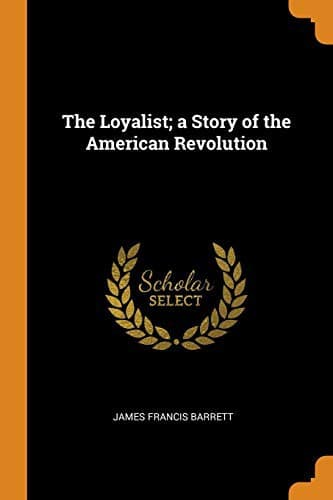
The Loyalist: A Story of the American RevolutionBarrett, James Francis
History
The Loyalist: A Story of the American Revolution
Barrett, James Francis
United States -- History -- Revolution, 1775-1783 -- Fiction
"Does he view matters in that light?"
"Did I say he did."
"Yes."
There was no further response.
Stephen had, by this time, become thoroughly exasperated with this man,
and was about to eject him forcibly from the room. His better judgment,
however, bade him restrain himself. A tilt in a public drinking house
would only noise his name abroad and perhaps give rise to much
unpleasantness.
"How can a man consistently be subject to any civil ruler when he
already has pledged his allegiance, both in soul and in body, to another
potentate?"
This from the man in black, the fourth member of the party, who
heretofore had maintained an impartial and respectful silence, not so
much from choice perhaps as through necessity. His name proved to be
John Anderson.
"You mean an alien?" Stephen inquired.
"If you are pleased so to term it. The Pope is a temporal lord, you
understand, and as such is due allegiance from every one of his
subjects."
And then Stephen took pains to explain, clearly and concisely, the great
difference between the two authorities--the civil and the religious. The
Prince of Peace had said, "Render unto Caeesar the things that are
Caeesar's, and to God the things that are God's," which declaration
admitted of an interpretation at once comprehensive and exclusive. He
explained how the Catholic found himself a member of two distinct and
perfect societies, each independent and absolute within its own sphere,
the one deriving its charter from the natural law, the other directly
from God. He then pointed out how these societies lived in perfect
harmony, although armed with two swords, the one spiritual, the other
temporal, weapons which were intended never to clash but to fight side
by side for the promotion of man's happiness, temporal and eternal.
"But it is inconceivable how a clash can be avoided," Mr. Anderson
reminded him.
"Not when it is remembered that each authority is independent of the
other. The Church has no power over civil legislation in matters purely
secular, nor has the state a right to interfere in ecclesiastical
legislation, in matters purely spiritual, nor over spiritual persons
considered strictly as such. In every Catholic country the King, as well
as the humblest peasant, is subject to the laws of his country in
secular matters, and to the laws of his church in matters spiritual."
"Yet at the same time he cannot fail to recognize that the one is
superior to the other."
"Only in so far as the spiritual order is superior to the secular."
"Not in temporal affairs as well?"
"Not in the least. Only in the recognition of the fact that the
salvation of the soul is of more importance than the welfare of the
body. In this is the mission of the state considered inferior to that of
the Church."
"If this be true, how can a Catholic pay allegiance to a society which
he believes to be a subordinate one?"
Public-domain text, read in full here on John Shaqi.
Reviews
Reviews
No reviews yet
Be the first to share your thoughts on this work.
Join the Discussion
Join the discussion
Sign in to leave a comment or review.
Sign InorCreate an account