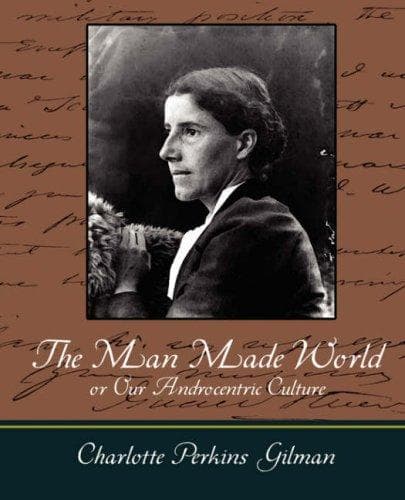
The Man-Made World; Or, Our Androcentric CultureGilman, Charlotte Perkins
General
The Man-Made World; Or, Our Androcentric Culture
Gilman, Charlotte Perkins
Women -- Social and moral questions; Women -- Social conditions
To this day we are living under the influence of the proprietary
family. The duty of the wife is held to involve man-service as well
as child-service, and indeed far more; as the duty of the wife to the
husband quite transcends the duty of the mother to the child.
See for instance the English wife staying with her husband in India and
sending the children home to be brought up; because India is bad
for children. See our common law that the man decides the place of
residence; if the wife refuses to go with him to howsoever unfit a place
for her and for the little ones, such refusal on her part constitutes
"desertion" and is ground for divorce.
See again the idea that the wife must remain with the husband though a
drunkard, or diseased; regardless of the sin against the child involved
in such a relation. Public feeling on these matters is indeed changing;
but as a whole the ideals of the man-made family still obtain.
The effect of this on the woman has been inevitably to weaken and
overshadow her sense of the real purpose of the family; of the
relentless responsibilities of her duty as a mother. She is first taught
duty to her parents, with heavy religious sanction; and then duty to
her husband, similarly buttressed; but her duty to her children has been
left to instinct. She is not taught in girlhood as to her preeminent
power and duty as a mother; her young ideals are all of devotion to the
lover and husband: with only the vaguest sense of results.
The young girl is reared in what we call "innocence;" poetically
described as "bloom;" and this condition is held one of her chief
"charms." The requisite is wholly androcentric. This "innocence" does
not enable her to choose a husband wisely; she does not even know the
dangers that possibly confront her. We vaguely imagine that her father
or brother, who do know, will protect her. Unfortunately the father and
brother, under our current "double standard" of morality do not judge
the applicants as she would if she knew the nature of their offenses.
Furthermore, if her heart is set on one of them, no amount of general
advice and opposition serves to prevent her marrying him. "I love him!"
she says, sublimely. "I do not care what he has done. I will forgive
him. I will save him!"
This state of mind serves to forward the interests of the lover, but
is of no advantage to the children. We have magnified the duties of the
wife, and minified the duties of the mother; and this is inevitable in
a family relation every law and custom of which is arranged from the
masculine viewpoint.
Public-domain text, read in full here on John Shaqi.
Reviews
Reviews
No reviews yet
Be the first to share your thoughts on this work.
Join the Discussion
Join the discussion
Sign in to leave a comment or review.
Sign InorCreate an account