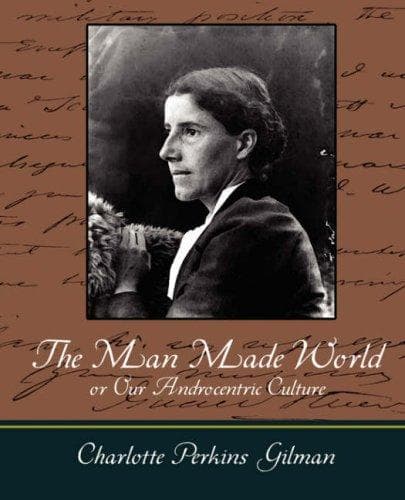
The Man-Made World; Or, Our Androcentric CultureGilman, Charlotte Perkins
General
The Man-Made World; Or, Our Androcentric Culture
Gilman, Charlotte Perkins
Women -- Social and moral questions; Women -- Social conditions
From this same viewpoint, equally essential to the proprietary family,
comes the requirement that the woman shall serve the man. Her service
is not that of the associate and equal, as when she joins him in his
business. It is not that of a beneficial combination, as when she
practices another business and they share the profits; it is not even
that of the specialist, as the service of a tailor or barber; it is
personal service--the work of a servant.
In large generalization, the women of the world cook and wash, sweep and
dust, sew and mend, for the men.
We are so accustomed to this relation; have held it for so long to be
the "natural" relation, that it is difficult indeed to show that it is
distinctly unnatural and injurious. The father expects to be served by
the daughter, a service quite different from what he expects of the son.
This shows at once that such service is no integral part of motherhood,
or even of marriage; but is supposed to be the proper industrial
position of women, as such.
Why is this so? Why, on the face of it, given a daughter and a son,
should a form of service be expected of the one, which would be
considered ignominious by the other?
The underlying reason is this. Industry, at its base, is a feminine
function. The surplus energy of the mother does not manifest itself in
noise, or combat, or display, but in productive industry. Because of her
mother-power she became the first inventor and laborer; being in truth
the mother of all industry as well as all people.
Man's entrance upon industry is late and reluctant; as will be shown
later in treating his effect on economics. In this field of family life,
his effect was as follows:
Establishing the proprietary family at an age when the industry was
primitive and domestic; and thereafter confining the woman solely to
the domestic area, he thereby confined her to primitive industry. The
domestic industries, in the hands of women, constitute a survival of
our remotest past. Such work was "woman's work" as was all the work then
known; such work is still considered woman's work because they have been
prevented from doing any other.
The term "domestic industry" does not define a certain kind of labor,
but a certain grade of labor. Architecture was a domestic industry
once--when every savage mother set up her own tepee. To be confined
to domestic industry is no proper distinction of womanhood; it is an
historic distinction, an economic distinction, it sets a date and limit
to woman's industrial progress.
In this respect the man-made family has resulted in arresting
the development of half the field. We have a world wherein men,
industrially, live in the twentieth century; and women, industrially,
live in the first--and back of it.
Public-domain text, read in full here on John Shaqi.
Reviews
Reviews
No reviews yet
Be the first to share your thoughts on this work.
Join the Discussion
Join the discussion
Sign in to leave a comment or review.
Sign InorCreate an account