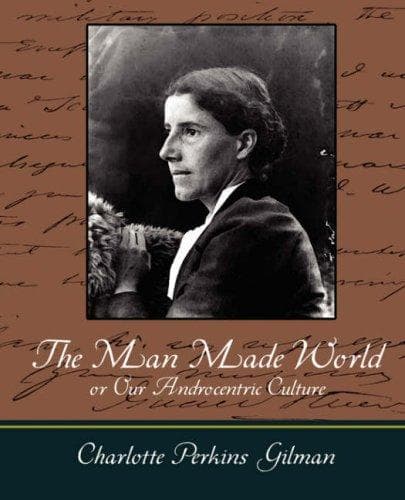
The Man-Made World; Or, Our Androcentric CultureGilman, Charlotte Perkins
General
The Man-Made World; Or, Our Androcentric Culture
Gilman, Charlotte Perkins
Women -- Social and moral questions; Women -- Social conditions
We are slowly forming a nobler type of family; the union of two, based
on love and recognized by law, maintained because of its happiness and
use. We are even now approaching a tenderness and permanence of
love, high pure enduring love; combined with the broad deep-rooted
friendliness and comradeship of equals; which promises us more happiness
in marriage than we have yet known. It will be good for all the parties
concerned--man, woman and child: and promote our general social progress
admirably.
If it needs "a head" it will elect a chairman pro tem. Friendship does
not need "a head." Love does not need "a head." Why should a family?
III. HEALTH AND BEAUTY.
NOTE--The word "Androcentric" we owe to Prof. Lester F.
Ward. In his book, "Pure Sociology," Chap. 14, he describes
the Androcentric Theory of life, hitherto universally
accepted; and introduces his own "Gyneacocentric Theory."
All who are interested in the deeper scientific aspects of
this question are urged to read that chapter. Prof. Ward's
theory is to my mind the most important that has been
offered the world since the Theory of Evolution; and without
exception the most important that has ever been put forward
concerning women.
Among the many paradoxes which we find in human life is our low average
standard of health and beauty, compared with our power and knowledge.
All creatures suffer from conflict with the elements; from enemies
without and within--the prowling devourers of the forest, and "the
terror that walketh in darkness" and attacks the body from inside, in
hidden millions.
Among wild animals generally, there is a certain standard of excellence;
if you shoot a bear or a bird, it is a fair sample of the species; you
do not say, "O what an ugly one!" or "This must have been an invalid!"
Where we have domesticated any animal, and interfered with its natural
habits, illness has followed; the dog is said to have the most diseases
second to man; the horse comes next; but the wild ones put us to
shame by their superior health and the beauty that belongs to right
development.
In our long ages of blind infancy we assume that sickness was a
visitation frown the gods; some still believe this, holding it to be a
special prerogative of divinity to afflict us in this way. We speak of
"the ills that flesh is heir to" as if the inheritance was entailed and
inalienable. Only of late years, after much study and long struggle with
this old belief which made us submit to sickness as a blow from the hand
of God, we are beginning to learn something of the many causes of our
many diseases, and how to remove some of them.
Public-domain text, read in full here on John Shaqi.
Reviews
Reviews
No reviews yet
Be the first to share your thoughts on this work.
Join the Discussion
Join the discussion
Sign in to leave a comment or review.
Sign InorCreate an account