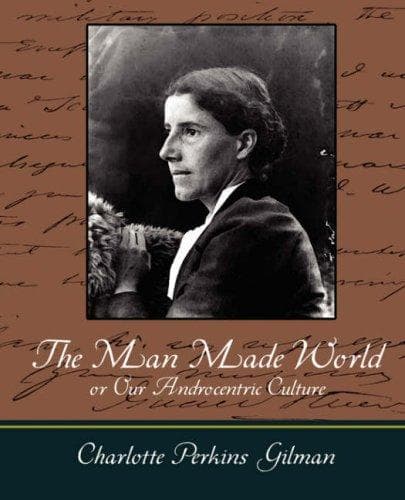
The Man-Made World; Or, Our Androcentric CultureGilman, Charlotte Perkins
General
The Man-Made World; Or, Our Androcentric Culture
Gilman, Charlotte Perkins
Women -- Social and moral questions; Women -- Social conditions
In our own species all this is changed. We have been so taken up with
the phenomena of masculinity and femininity, that our common humanity
has largely escaped notice. We know we are human, naturally, and are
very proud of it; but we do not consider in what our humanness consists;
nor how men and women may fall short of it, or overstep its bounds, in
continual insistence upon their special differences. It is "manly" to do
this; it is "womanly" to do that; but what a human being should do under
the circumstances is not thought of.
The only time when we do recognize what we call "common humanity" is in
extreme cases, matters of life and death; when either man or woman is
expected to behave as if they were also human creatures. Since the range
of feeling and action proper to humanity, as such, is far wider than
that proper to either sex, it seems at first somewhat remarkable that we
have given it so little recognition.
A little classification will help us here. We have certain qualities in
common with inanimate matter, such as weight, opacity, resilience. It is
clear that these are not human. We have other qualities in common with
all forms of life; cellular construction, for instance, the reproduction
of cells and the need of nutrition. These again are not human. We
have others, many others, common to the higher mammals; which are not
exclusively ours--are not distinctively "human." What then are true
human characteristics? In what way is the human species distinguished
from all other species?
Our human-ness is seen most clearly in three main lines: it is
mechanical, psychical and social. Our power to make and use things is
essentially human; we alone have extra-physical tools. We have added to
our teeth the knife, sword, scissors, mowing machine; to our claws the
spade, harrow, plough, drill, dredge. We are a protean creature, using
the larger brain power through a wide variety of changing weapons. This
is one of our main and vital distinctions. Ancient animal races are
traced and known by mere bones and shells, ancient human races by their
buildings, tools and utensils.
That degree of development which gives us the human mind is a clear
distinction of race. The savage who can count a hundred is more human
than the savage who can count ten.
More prominent than either of these is the social nature of humanity. We
are by no means the only group-animal; that ancient type of industry the
ant, and even the well-worn bee, are social creatures. But insects of
their kind are found living alone. Human beings never. Our human-ness
begins with some low form of social relation and increases as that
relation develops.
Public-domain text, read in full here on John Shaqi.
Reviews
Reviews
No reviews yet
Be the first to share your thoughts on this work.
Join the Discussion
Join the discussion
Sign in to leave a comment or review.
Sign InorCreate an account