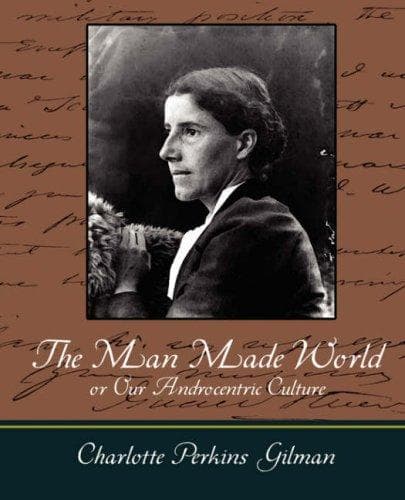
The Man-Made World; Or, Our Androcentric CultureGilman, Charlotte Perkins
General
The Man-Made World; Or, Our Androcentric Culture
Gilman, Charlotte Perkins
Women -- Social and moral questions; Women -- Social conditions
Human life of any sort is dependent upon what Kropotkin calls "mutual
aid," and human progress keeps step absolutely with that interchange of
specialized services which makes society organic. The nomad, living on
cattle as ants live on theirs, is less human than the farmer, raising
food by intelligently applied labor; and the extension of trade and
commerce, from mere village market-places to the world-exchanges of
to-day, is extension of human-ness as well.
Humanity, thus considered, is not a thing made at once and unchangeable,
but a stage of development; and is still, as Wells describes it, "in
the making." Our human-ness is seen to lie not so much in what we
are individually, as in our relations to one another; and even that
individuality is but the result of our relations to one another. It
is in what we do and how we do it, rather than in what we are. Some,
philosophically inclined, exalt "being" over "doing." To them this
question may be put: "Can you mention any form of life that merely 'is,'
without doing anything?"
Taken separately and physically, we are animals, _genus homo_; taken
socially and psychically, we are, in varying degree, human; and our real
history lies in the development of this human-ness.
Our historic period is not very long. Real written history only goes
back a few thousand years, beginning with the stone records of ancient
Egypt. During this period we have had almost universally what is here
called an Androcentric Culture. The history, such as it was, was made
and written by men.
The mental, the mechanical, the social development, was almost wholly
theirs. We have, so far, lived and suffered and died in a man-made
world. So general, so unbroken, has been this condition, that to mention
it arouses no more remark than the statement of a natural law. We have
taken it for granted, since the dawn of civilization, that "mankind"
meant men-kind, and the world was theirs.
Women we have sharply delimited. Women were a sex, "the sex," according
to chivalrous toasts; they were set apart for special services peculiar
to femininity. As one English scientist put it, in 1888, "Women are not
only not the race--they are not even half the race, but a subspecies
told off for reproduction only."
This mental attitude toward women is even more clearly expressed by
Mr. H. B. Marriot-Watson in his article on "The American Woman" in the
"Nineteenth Century" for June, 1904, where he says: "Her constitutional
restlessness has caused her to abdicate those functions which alone
excuse or explain her existence." This is a peculiarly happy and
condensed expression of the relative position of women during our
androcentric culture. The man was accepted as the race type without one
dissentient voice; and the woman--a strange, diverse creature, quite
disharmonious in the accepted scheme of things--was excused and
explained only as a female.
Public-domain text, read in full here on John Shaqi.
Reviews
Reviews
No reviews yet
Be the first to share your thoughts on this work.
Join the Discussion
Join the discussion
Sign in to leave a comment or review.
Sign InorCreate an account