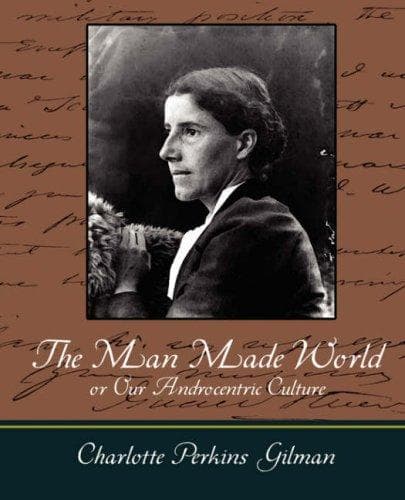
The Man-Made World; Or, Our Androcentric CultureGilman, Charlotte Perkins
General
The Man-Made World; Or, Our Androcentric Culture
Gilman, Charlotte Perkins
Women -- Social and moral questions; Women -- Social conditions
In lower animals, speaking generally, the powers of the race must be
lodged in each individual. No gain of personal experience is of avail to
the others. No advantages remain, save those physically transmitted. The
narrow limits of personal gain and personal inheritance rigidly hem
in sub-human progress. With us, what one learns may be taught to the
others. Our life is social, collective. Our gain is for all, and profits
us in proportion as we extend it to all. As the human soul develops in
us, we become able to grasp more fully our common needs and advantages;
and with this growth has come the extension of education to the people
as a whole. Social functions are developed under natural laws, like
physical ones, and may be studied similarly.
In the evolution of this basic social function, what has been the effect
of wholly masculine influence?
The original process, instruction of individual child by individual
mother, has been largely neglected in our man-made world. That was
considered as a subsidiary sex-function of the woman, and as such,
left to her "instinct." This is the main reason why we show such great
progress in education for older children, and especially for youths, and
so little comparatively in that given to little ones.
We have had on the one side the natural current of maternal education,
with its first assistant, the nursemaid, and its second, the
"dame-school"; and on the other the influence of the dominant class,
organized in university, college, and public school, slowly filtering
downward.
Educational forces are many. The child is born into certain conditions,
physical and psychic, and "educated" thereby. He grows up into social,
political and economic conditions, and is further modified by them. All
these conditions, so far, have been of androcentric character; but
what we call education as a special social process is what the child is
deliberately taught and subjected to; and it is here we may see the same
dominant influence so clearly.
This conscious education was, for long, given to boys alone, the girls
being left to maternal influence, each to learn what her mother knew,
and no more. This very clear instance of the masculine theory is glaring
enough by itself to rest a case on. It shows how absolute was the
assumption that the world was composed of men, and men alone were to be
fitted for it. Women were no part of the world, and needed no training
for its uses. As females they were born and not made; as human beings
they were only servants, trained as such by their servant mothers.
This system of education we are outgrowing more swiftly with each year.
The growing humanness of women, and its recognition, is forcing an equal
education for boy and girl. When this demand was first made, by women
of unusual calibre, and by men sufficiently human to overlook
sex-prejudice, how was it met? What was the attitude of woman's "natural
protector" when she began to ask some share in human life?
Public-domain text, read in full here on John Shaqi.
Reviews
Reviews
No reviews yet
Be the first to share your thoughts on this work.
Join the Discussion
Join the discussion
Sign in to leave a comment or review.
Sign InorCreate an account