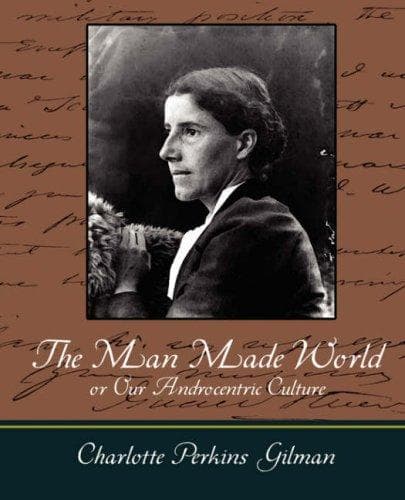
The Man-Made World; Or, Our Androcentric CultureGilman, Charlotte Perkins
General
The Man-Made World; Or, Our Androcentric Culture
Gilman, Charlotte Perkins
Women -- Social and moral questions; Women -- Social conditions
If a given idea has been held in the human mind for many generations, as
almost all our common ideas have, it takes sincere and continued effort
to remove it; and if it is one of the oldest we have in stock, one of
the big, common, unquestioned world ideas, vast is the labor of those
who seek to change it.
Nevertheless, if the matter is one of importance, if the previous idea
was a palpable error, of large and evil effect, and if the new one is
true and widely important, the effort is worth making.
The task here undertaken is of this sort. It seeks to show that what we
have all this time called "human nature" and deprecated, was in great
part only male nature, and good enough in its place; that what we have
called "masculine" and admired as such, was in large part human, and
should be applied to both sexes: that what we have called "feminine"
and condemned, was also largely human and applicable to both. Our
androcentric culture is so shown to have been, and still to be, a
masculine culture in excess, and therefore undesirable.
In the preliminary work of approaching these facts it will be well to
explain how it can be that so wide and serious an error should have been
made by practically all men. The reason is simply that they were men.
They were males, avid saw women as females--and not otherwise.
So absolute is this conviction that the man who reads will say, "Of
course! How else are we to look at women except as females? They are
females, aren't they?" Yes, they are, as men are males unquestionably;
but there is possible the frame of mind of the old marquise who was
asked by an English friend how she could bear to have the footman serve
her breakfast in bed--to have a man in her bed-chamber--and replied
sincerely, "Call you that thing there a man?"
The world is full of men, but their principal occupation is human
work of some sort; and women see in them the human distinction
preponderantly. Occasionally some unhappy lady marries her
coachman--long contemplation of broad shoulders having an effect,
apparently; but in general women see the human creature most; the male
creature only when they love.
To the man, the whole world was his world; his because he was male; and
the whole world of woman was the home; because she was female. She had
her prescribed sphere, strictly limited to her feminine occupations and
interests; he had all the rest of life; and not only so, but, having it,
insisted on calling it male.
This accounts for the general attitude of men toward the now rapid
humanization of women. From her first faint struggles toward freedom
and justice, to her present valiant efforts toward full economic and
political equality, each step has been termed "unfeminine" and resented
as an intrusion upon man's place and power. Here shows the need of our
new classification, of the three distinct fields of life--masculine,
feminine and human.
Public-domain text, read in full here on John Shaqi.
Reviews
Reviews
No reviews yet
Be the first to share your thoughts on this work.
Join the Discussion
Join the discussion
Sign in to leave a comment or review.
Sign InorCreate an account