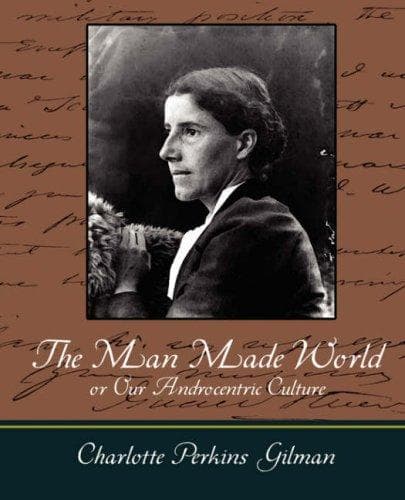
The Man-Made World; Or, Our Androcentric CultureGilman, Charlotte Perkins
General
The Man-Made World; Or, Our Androcentric Culture
Gilman, Charlotte Perkins
Women -- Social and moral questions; Women -- Social conditions
As a matter of fact, there is a "woman's sphere," sharply defined and
quite different from his; there is also a "man's sphere," as sharply
defined and even more limited; but there remains a common sphere--that
of humanity, which belongs to both alike.
In the earlier part of what is known as "the woman's movement," it was
sharply opposed on the ground that women would become "unsexed." Let us
note in passing that they have become unsexed in one particular, most
glaringly so, and that no one has noticed or objected to it.
As part of our androcentric culture we may point to the peculiar
reversal of sex characteristics which make the human female carry the
burden of ornament. She alone, of all human creatures, has adopted the
essentially masculine attribute of special sex-decoration; she does not
fight for her mate as yet, but she blooms forth as the peacock and
bird of paradise, in poignant reversal of nature's laws, even wearing
masculine feathers to further her feminine ends.
Woman's natural work as a female is that of the mother; man's natural
work as a male is that of the father; their mutual relation to this end
being a source of joy and well-being when rightly held: but human work
covers all our life outside of these specialties. Every handicraft,
every profession, every science, every art, all normal amusements and
recreations, all government, education, religion; the whole living world
of human achievement: all this is human.
That one sex should have monopolized all human activities, called them
"man's work," and managed them as such, is what is meant by the phrase
"Androcentric Culture."
II. THE MAN-MADE FAMILY.
The family is older than humanity, and therefore cannot be called
a human institution. A post office, now, is wholly human; no other
creature has a post office, but there are families in plenty among birds
and beasts; all kinds permanent and transient; monogamous, polygamous
and polyandrous.
We are now to consider the growth of the family in humanity; what is
its rational development in humanness; in mechanical, mental and social
lines; in the extension of love and service; and the effect upon it of
this strange new arrangement--a masculine proprietor.
Like all natural institutions the family has a purpose; and is to be
measured primarily as it serves that purpose; which is, the care and
nurture of the young. To protect the helpless little ones, to feed and
shelter them, to ensure them the benefits of an ever longer period of
immaturity, and so to improve the race--this is the original purpose of
the family.
When a natural institution becomes human it enters the plane of
consciousness. We think about it; and, in our strange new power of
voluntary action do things to it. We have done strange things to the
family; or, more specifically, men have.
Public-domain text, read in full here on John Shaqi.
Reviews
Reviews
No reviews yet
Be the first to share your thoughts on this work.
Join the Discussion
Join the discussion
Sign in to leave a comment or review.
Sign InorCreate an account