The Man of Last Resort; Or, The Clients of Randolph Mason — John Shaqi
The Man of Last Resort; Or, The Clients of Randolph MasonPost, Melville Davisson
General
The Man of Last Resort; Or, The Clients of Randolph Mason
Post, Melville Davisson
American fiction -- 19th century; Detective and mystery stories, American; Legal stories, American
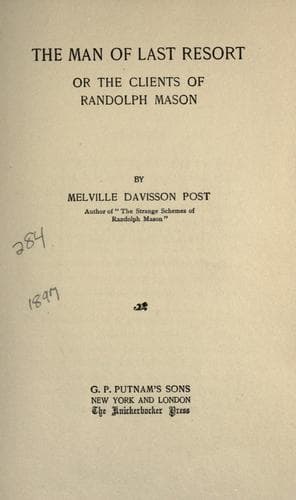
THE MAN OF LAST RESORT
Or, The Clients Of Randolph Mason
By Melville Davisson Post
G. P. Putnam's Sons New York And London
1897
PREFACE
IN this _fin-de-sîècle_ time, society has grown liberal, it is said,
and yet he who thrusts a lever under sage customs, or he who points out
the vice of institutions long established, may deem himself happy if he
be permitted to strip against the duellist rather than the mob. Even
if one come new into the courts of the _literati_ with a cloak dyed a
different hue from his fellows, he will scarcely have passed the doorway
ere the taunting challenge, “Do you fight, my lord?”
The author, in a previous volume entitled _The Strange Schemes of
Randolph Mason_, pointed out certain defects in the criminal law, and
demonstrated how the skilful rogue could commit not a few of the higher
crimes in such a manner as to render the law powerless to punish him.
The suggestion was, it seems, considered startling and the volume has
provoked large discussion. A few gentlemen of no inconsiderable legal
learning, and certain others to be classified as moral reformers,
contended that the book must be dangerous because it explained with
great detail how one could murder or steal and escape punishment. If the
laws were to be improved, they said, “would it not be more wisely done
by influencing a few political leaders?”
While such a criticism does not come from any considerable number of
authorities, it has been honestly made and is entitled to consideration.
The vice of it lies, it seems to me, in a failure to grasp the actual
nature of our institutions. It is a maxim of our system that the law
making power of the state rests in the first instance with the people of
the state. This power, for the purpose of convenience, is delegated to
certain selected persons who meet together in order to put into effect
the will of the people.
Public-domain text, read in full here on John Shaqi.
Reviews
Reviews
No reviews yet
Be the first to share your thoughts on this work.
Join the Discussion
Join the discussion
Sign in to leave a comment or review.
Sign InorCreate an account