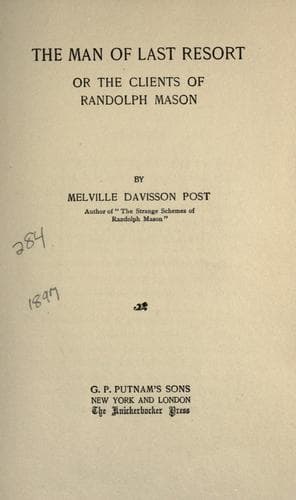
The Man of Last Resort; Or, The Clients of Randolph MasonPost, Melville Davisson
General
The Man of Last Resort; Or, The Clients of Randolph Mason
Post, Melville Davisson
American fiction -- 19th century; Detective and mystery stories, American; Legal stories, American
The so-called law-makers are therefore not law-makers at all, in the
sense of being originators of the law; they are rather agents who come
up from their respective districts under instructions. Such agents are
simply temporary representatives of the citizens of their respective
districts, directly responsible to them and charged with no duty other
than that of putting their will into effect. The agent or delegate
should therefore approach very conservatively any matter upon which the
will of his constituency has not been satisfactorily determined. It is,
then, apparent that the influence which makes or which alters the law
is a force exerted from without. No change in the law can be properly
or safely brought about except through the pressure of public sentiment.
The need for the law must be first felt by the people and the demand for
it made before the legislator is warranted in acting. The representative
would otherwise become a presumptive usurper, afflicting the people
with statutes for which there was no public demand; and such laws, so
improperly obtained, would be without the support of public sentiment
and would be liable to repeal.
Hence it is entirely clear that if the existing law prove to be unjust
or defective, the people must be brought to see and appreciate such
injustice or inadequacy and to demand the requisite modification.
This contention can, as it seems to me, not be gainsaid. It is
respectfully urged that no other method of securing wise changes in
the law can be properly pursued under democratic institutions. To hold
otherwise is to take issue with the wisdom of democracy itself, and with
so rash a champion the writer has no spear to break. Indeed, he makes
this explanation with immense unwillingness, as he feels that he should
not be required to defend a truth so evident. It is like demonstrating
gravely that the earth is round and that sun light is an energy.
Yet he is advised that attention should be called to this matter, lest
the thoughtless condemn upon a hearing _ex-parte_. Indeed, even after
the punishment of _la peine forte et dure_ is gone out these many
hundred years, the good citizen will hardly hold that one guiltless who
stands dumb while hidden evils assail. If men about their affairs were
passing to and fro across a great bridge, and one should discover that
certain planks in its flooring were defective, would he do ill if he
pointed them out to his fellows? If men labored in the shops and traded
in the market confident in the security of their city's wall, and one
should perceive that the wall was honeycombed with holes, could he stand
dumb and escape the stigma of being a traitor? The law makes little
difference in the degree of moral turpitude between the _suppressio
veri_ and the _suggestio falsi_. Both are grievous wrongs. The duty
of the individual to the state is imperative. He cannot evade it and
continue to regard himself as a worthy citizen.
Public-domain text, read in full here on John Shaqi.
Reviews
Reviews
No reviews yet
Be the first to share your thoughts on this work.
Join the Discussion
Join the discussion
Sign in to leave a comment or review.
Sign InorCreate an account