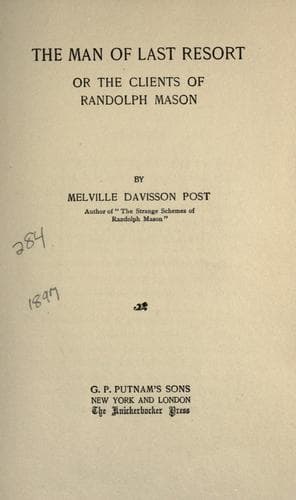
The Man of Last Resort; Or, The Clients of Randolph MasonPost, Melville Davisson
General
The Man of Last Resort; Or, The Clients of Randolph Mason
Post, Melville Davisson
American fiction -- 19th century; Detective and mystery stories, American; Legal stories, American
THE audience in the court-room arose and remained standing until the
judge in his black silk robe had entered and taken his place on the
bench. Then the audience resumed its seat, and the clerk began to read
the proceedings for the previous day. The ceremony attendant upon the
sitting of the Circuit Court of the United States carried with it an
impressive sense of majestic, imperial authority, and an air of grave,
judicial deliberation. It was the Government of the United States of
America, the spirit of supreme order and law moving through its servant,
and, next to the Great Ruler of Events, it was greatest. It had assumed
for the good of men the right to sit in judgment, and to say wherein lay
the justice of their complicated quarrels. Before it, every man's cause
was of equal import, and every man was of equal stature; bond or free,
one stood before it naked of influence, and with his shoulder made as
high as the shoulder of his fellow.
This is the theory. If it fails, it is because the law at best is but a
human device, and its servants, after all, are but men like the others.
The building in which the Federal Court held its session was a
substantial, handsome structure, and maintained a strange contrast to
the town in which it stood. The town was rough, miserable, uncouth;
the temporary habitation of men, struggling ever with the relentless
_ananke_ of things; in equal contrast to the officers of this court
was the audience in the great court-room. They were the pioneers of
civilization; a motley crowd in which the best and worst of human
society was mixed and intermixed. They were, for the most part, bronzed,
bearded, fearless examples of the inexorable law of the survival of the
fittest, but not all. Some were the reckless advance agents of those
hardy vices that follow close in the wake of empire,--devils too
villainous to be tolerated in the cities of the East, and too bold and
too wary to be stamped out by the deliberate machinery of the law.
Against these the officers of the court bore some evidence of polish.
They were exact, calculating men, bred to respect order, and obey and
maintain the customs of law. The contrast was significant, and one
recalled and understood the constant bitter conflict between the
judicial tribunals of the State and the judicial tribunals of the
Federal Government, bitterly waged and as yet undecided. From one
standpoint, this was the calm tribunal of the supreme power of the
land, providing the same rights and remedies on the very border of
its jurisdiction that it provided at the capital itself, favoring no
condition and acting as even-eyed as nature.
Public-domain text, read in full here on John Shaqi.
Reviews
Reviews
No reviews yet
Be the first to share your thoughts on this work.
Join the Discussion
Join the discussion
Sign in to leave a comment or review.
Sign InorCreate an account