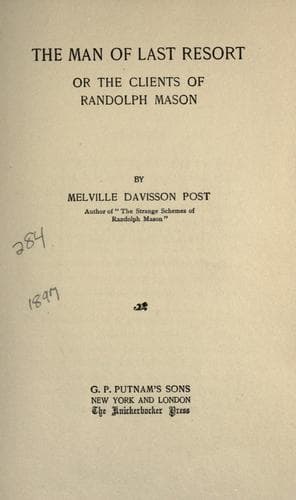
The Man of Last Resort; Or, The Clients of Randolph MasonPost, Melville Davisson
General
The Man of Last Resort; Or, The Clients of Randolph Mason
Post, Melville Davisson
American fiction -- 19th century; Detective and mystery stories, American; Legal stories, American
On the other hand, one understood how the remote Commonwealth held this
court to be the tribunal of a far off imperial government, seeking to
enforce laws and customs foreign and repugnant to the laws and customs
of its people. To them the Federal judge was a king's governor,
travelling with his retinue over a subjugated province, and enforcing
his edict by virtue of foreign armies quartered convenient to his hand.
And looking on from this point of view, one understood why the outpost
State hated this court so bitterly, and whence arose the fierce
clamor against it. One understood how the far West smarted under its
injunctions, and denounced them as the royal mandates of an emperor's
consul, and how the far South collided with this tribunal and cried out
against it to the Congress of the United States in a memorial clanging
like a bell.
So the conflict was easy to understand, and it was easy to appreciate
how large the spectre of discord loomed, and most difficult indeed to
force the problem to some happy end.
When the clerk had finished, the marshal called the jury, and struggled
bravely, but at times unsuccessfully, with the marvellous tangle of
names. Indeed, if the list of this panel had been placed before a
student of philology, he would have required no further history of the
civilization of the Southwest. When the marshal had ended, the judge
directed that the jury should be dismissed until two o'clock, and when
order was again restored, the judge turned and looked down gravely from
the bench.
“This court,” he said, “is ready to pass upon the matter taken under
advisement yesterday afternoon. It seems that one Hiram Martin, a
citizen of and a resident in the State of New Mexico, brought an action
in this court against Ambercrombie Hergan and others to recover the sum
of fifty thousand dollars, money, as it is said, borrowed by the said
Hergan. The declaration contained the common counts _in assumpsit_, with
which was filed, in lieu of the bill of particulars, a promissory
note, made by the said Hergan to the said plaintiff, calling for fifty
thousand dollars, and endorsed by one Randal and another Culver-son.
This note, in addition to the matter usually had in such instruments,
recited that it was given in accord with a certain agreement of even
date therewith, made and entered into by the parties to the said
note. The case coming on for trial, the defendants, by their attorney,
appeared and filed their plea exhibiting the said agreement, maintaining
that the said note was given for money loaned for the purpose of being
used in a gambling venture, and was, therefore, void at law. An issue
being had upon the said plea, the case was put to trial, and the said
agreement having been admitted, the defendants, by their attorney, moved
this court to exclude the evidence, and direct the jury to find for the
defendants; which motion this court took time to consider.
Public-domain text, read in full here on John Shaqi.
Reviews
Reviews
No reviews yet
Be the first to share your thoughts on this work.
Join the Discussion
Join the discussion
Sign in to leave a comment or review.
Sign InorCreate an account