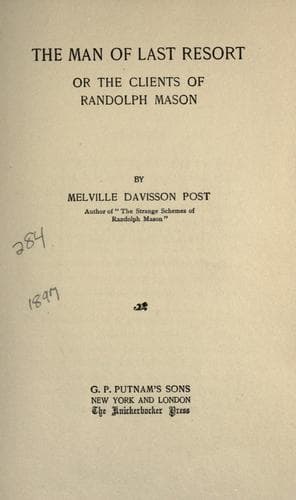
The Man of Last Resort; Or, The Clients of Randolph Mason — John Shaqi
The Man of Last Resort; Or, The Clients of Randolph MasonPost, Melville Davisson
General
The Man of Last Resort; Or, The Clients of Randolph Mason
Post, Melville Davisson
American fiction -- 19th century; Detective and mystery stories, American; Legal stories, American
“The objection is ingenious, but I judge fully met by the declaration
of Lord Mansfield in Holman's case: 'The objection,' said the learned
judge, 'that a contract is immoral or illegal as between plaintiff and
defendant, sounds at all times very ill in the mouth of the defendant.
It is not for his sake, however, that the objection is allowed, but it
is founded on the general principle of policy which the defendant has
the advantage of, contrary to the real justice as between himself and
plaintiff, by accident, if I may so say. The principle of public policy
is this: _ex dolo malo non oritur actio_. No court will lend its aid to
a man who founds his cause of action upon an immoral or illegal act.
If from the plaintiff's own statement or otherwise the cause of action
appear to arise _ex turpi causa_, or the transgression of a positive law
of this country, then the court says he has no right to be assisted. It
is upon that ground the court goes, not for the sake of the defendant,
but because it will not lend its aid to such a plaintiff.'
“This claim of the plaintiff to this action is unsound for the further
reason that any promise, contract, or undertaking the performance of
which would tend to promote, advance, or carry into effect an object
or purpose which is unlawful, is itself void and will not maintain
an action. The law which prohibits the end, will not lend its aid in
promoting the means assigned to carry it into effect. Nor is it
possible for an act contrary to law to be made the basis of a contract
enforceable in courts of law. Hence when one lends money to another for
the express purpose of enabling him to commit a specific unlawful act,
and such act be afterwards committed by means of the aid so received,
the lender is a _particeps criminis_, and the law will not aid him to
recover money advanced for such a purpose, and much less would it assist
him, if, as in this case he retained an interest in the result of the
venture.”
It was very unusual for counsel to interrupt the judge in the delivery
of his opinion, but at this point the attorney for Martin arose.
“If your honor please,” he said, “this court is taking away the remedy
of the plaintiff, and permitting the wrong to stand. Does this court
reverse the ancient doctrine upon which the theory of human justice has
its eternal basis, the ancient doctrine that the law will always provide
a remedy for a wrong?”
The faintest shadow of a smile flitted over the judicial face.
“That sage maxim: '_lex semper debit remédiant_,'” answered the judge,
“is a gigantic error couched in very good law Latin. The motion to
exclude the evidence is sustained, and the jury will find a verdict for
the defendants.”
X
Public-domain text, read in full here on John Shaqi.
Reviews
Reviews
No reviews yet
Be the first to share your thoughts on this work.
Join the Discussion
Join the discussion
Sign in to leave a comment or review.
Sign InorCreate an account