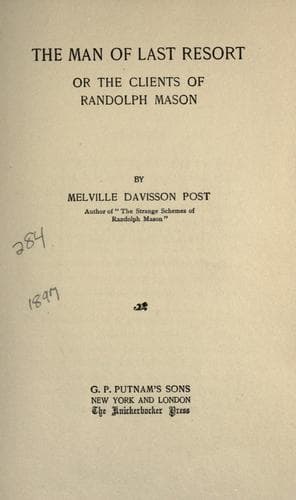
The Man of Last Resort; Or, The Clients of Randolph MasonPost, Melville Davisson
General
The Man of Last Resort; Or, The Clients of Randolph Mason
Post, Melville Davisson
American fiction -- 19th century; Detective and mystery stories, American; Legal stories, American
“Indeed the courts of the land have gone to the extremity of denouncing
in no uncertain terms the dangerous character of these illegal ventures.
Judge Blauford, in the case of Cunningham vs. The National Bank of
Augusta, in speaking of these transactions termed 'futures,' declares:
'If this is not a speculation on chances--a wagering and betting between
the parties, then we are unable to understand the transaction. A betting
on a game of faro or poker cannot be more hazardous, dangerous, or
uncertain. Indeed it may be said that these animals are tame, gentle,
and submissive compared to this monster. The law has caged them and
driven them to the den. They have been outlawed; while this ferocious
beast has been allowed to stalk about in open mid-day with gilded signs
and flaming advertisements to lure the unhappy victim to its embrace
of death and destruction. What are some of the consequences of these
speculations in 'futures'? The faithful chroniclers of the day have
informed us, as growing directly out of these nefarious practices,
that there have been bankruptcies, defalcations of public officers,
embezzlements, forgeries, larcenies, and deaths. Certainly no one
will contend for a moment that a transaction fraught with such evil
consequences is not immoral, illegal, and contrary to public policy.'
“In so far as this doctrine is concerned with the case at bar, it is
certain that the parties understood and intended that the money loaned
should be used for the purpose of engaging in an illegal speculation in
oil,--'a gamble in oil,' as it is termed in the agreement, and that such
gambling transactions are against public policy and the law of the land.
But it is contended by learned counsel that all this can have no bearing
upon the case at bar for the reason that in the cases heretofore cited
announcing these conclusions of law, the litigants were the parties who
dealt with or for each other, and were the immediate parties engaged in
an unlawful gambling venture, and the ones to gain or lose directly
by the venture, and not a mere stranger who loaned money to another to
engage in such transactions, and having but an undetermined interest in
the result; and that the law will not lend its aid to a further wrong.
The defendant having committed one wrong cannot be permitted to use his
first wrongful act as an instrument whereby to effect a second wrongful
act.
Public-domain text, read in full here on John Shaqi.
Reviews
Reviews
No reviews yet
Be the first to share your thoughts on this work.
Join the Discussion
Join the discussion
Sign in to leave a comment or review.
Sign InorCreate an account