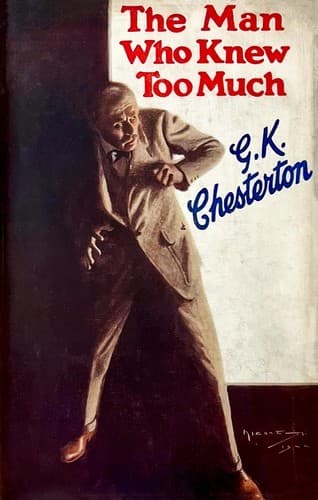
The Man Who Knew Too MuchChesterton, G. K. (Gilbert Keith)
ReligionComparative
The Man Who Knew Too Much
Chesterton, G. K. (Gilbert Keith)
Aristocracy (Social class) -- Fiction; Detective and mystery stories, English; Great Britain -- Fiction
"It would be heard. But it would not be noticed. That," continued
the investigator, "is where he was clever again. Shooting was going
on all over the place all day; very likely he timed his shot so as
to drown it in a number of others. Certainly he was a first-class
criminal. And he was something else as well."
"What do you mean?" asked his companion, with a creepy premonition
of something coming, he knew not why.
"He was a first-class shot," said Fisher. He had turned his back
abruptly and was walking down a narrow, grassy lane, little more
than a cart track, which lay opposite the inn and marked the end of
the great estate and the beginning of the open moors. March plodded
after him with the same idle perseverance, and found him staring
through a gap in giant weeds and thorns at the flat face of a
painted paling. From behind the paling rose the great gray columns
of a row of poplars, which filled the heavens above them with
dark-green shadow and shook faintly in a wind which had sunk slowly
into a breeze. The afternoon was already deepening into evening, and
the titanic shadows of the poplars lengthened over a third of the
landscape.
"Are you a first-class criminal?" asked Fisher, in a friendly tone.
"I'm afraid I'm not. But I think I can manage to be a sort of
fourth-rate burglar."
And before his companion could reply he had managed to swing himself
up and over the fence; March followed without much bodily effort,
but with considerable mental disturbance. The poplars grew so close
against the fence that they had some difficulty in slipping past
them, and beyond the poplars they could see only a high hedge of
laurel, green and lustrous in the level sun. Something in this
limitation by a series of living walls made him feel as if he were
really entering a shattered house instead of an open field. It was
as if he came in by a disused door or window and found the way
blocked by furniture. When they had circumvented the laurel hedge,
they came out on a sort of terrace of turf, which fell by one green
step to an oblong lawn like a bowling green. Beyond this was the
only building in sight, a low conservatory, which seemed far away
from anywhere, like a glass cottage standing in its own fields in
fairyland. Fisher knew that lonely look of the outlying parts of a
great house well enough. He realized that it is more of a satire on
aristocracy than if it were choked with weeds and littered with
ruins. For it is not neglected and yet it is deserted; at any rate,
it is disused. It is regularly swept and garnished for a master who
never comes.
Public-domain text, read in full here on John Shaqi.
Reviews
Reviews
No reviews yet
Be the first to share your thoughts on this work.
Join the Discussion
Join the discussion
Sign in to leave a comment or review.
Sign InorCreate an account