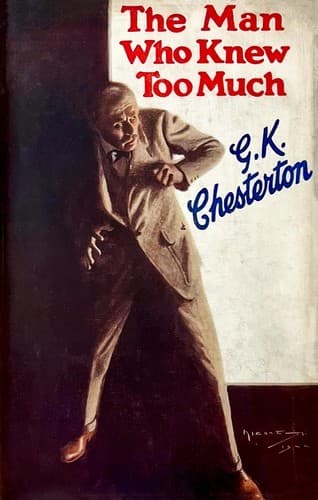
The Man Who Knew Too MuchChesterton, G. K. (Gilbert Keith)
ReligionComparative
The Man Who Knew Too Much
Chesterton, G. K. (Gilbert Keith)
Aristocracy (Social class) -- Fiction; Detective and mystery stories, English; Great Britain -- Fiction
He looked rather older than his boyish portraits in the illustrated
papers, as is the way of politicians; his flat, fair hair was
touched with gray, but his face was almost comically round, with a
Roman nose which, when combined with his quick, bright eyes, raised
a vague reminiscence of a parrot. He had a cap rather at the back of
his head and a gun under his arm. Harold March had imagined many
things about his meeting with the great political reformer, but he
had never pictured him with a gun under his arm, drinking brandy in
a public house.
"So you're stopping at Jink's, too," said Fisher. "Everybody seems
to be at Jink's."
"Yes," replied the Chancellor of the Exchequer. "Jolly good
shooting. At least all of it that isn't Jink's shooting. I never
knew a chap with such good shooting that was such a bad shot. Mind
you, he's a jolly good fellow and all that; I don't say a word
against him. But he never learned to hold a gun when he was packing
pork or whatever he did. They say he shot the cockade off his own
servant's hat; just like him to have cockades, of course. He shot
the weathercock off his own ridiculous gilded summerhouse. It's the
only cock he'll ever kill, I should think. Are you coming up there
now?"
Fisher said, rather vaguely, that he was following soon, when he had
fixed something up; and the Chancellor of the Exchequer left the
inn. March fancied he had been a little upset or impatient when he
called for the brandy; but he had talked himself back into a
satisfactory state, if the talk had not been quite what his literary
visitor had expected. Fisher, a few minutes afterward, slowly led
the way out of the tavern and stood in the middle of the road,
looking down in the direction from which they had traveled. Then he
walked back about two hundred yards in that direction and stood
still again.
"I should think this is about the place," he said.
"What place?" asked his companion.
"The place where the poor fellow was killed," said Fisher, sadly.
"What do you mean?" demanded March.
"He was smashed up on the rocks a mile and a half from here."
"No, he wasn't," replied Fisher. "He didn't fall on the rocks at
all. Didn't you notice that he only fell on the slope of soft grass
underneath? But I saw that he had a bullet in him already."
Then after a pause he added:
"He was alive at the inn, but he was dead long before he came to the
rocks. So he was shot as he drove his car down this strip of
straight road, and I should think somewhere about here. After that,
of course, the car went straight on with nobody to stop or turn it.
It's really a very cunning dodge in its way; for the body would be
found far away, and most people would say, as you do, that it was an
accident to a motorist. The murderer must have been a clever brute."
"But wouldn't the shot be heard at the inn or somewhere?" asked
March.
Public-domain text, read in full here on John Shaqi.
Reviews
Reviews
No reviews yet
Be the first to share your thoughts on this work.
Join the Discussion
Join the discussion
Sign in to leave a comment or review.
Sign InorCreate an account