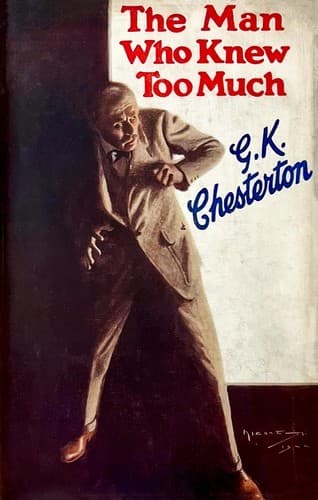
The Man Who Knew Too MuchChesterton, G. K. (Gilbert Keith)
ReligionComparative
The Man Who Knew Too Much
Chesterton, G. K. (Gilbert Keith)
Aristocracy (Social class) -- Fiction; Detective and mystery stories, English; Great Britain -- Fiction
"I think I do," said Horne Fisher, "and before I go on to more
extraordinary things I will, say what I think. Squire Hawker played
both the bigamist and the bandit. His first wife was not dead when
he married the Jewess; she was imprisoned on this island. She bore
him a child here, who now haunts his birthplace under the name of
Long Adam. A bankruptcy company promoter named Werner discovered the
secret and blackmailed the squire into surrendering the estate.
That's all quite clear and very easy. And now let me go on to
something more difficult. And that is for you to explain what the
devil you are doing kidnaping your born brother."
After a pause Henry Fisher answered:
"I suppose you didn't expect to see me," he said. "But, after all,
what could you expect?"'
"I'm afraid I don't follow," said Horne Fisher.
"I mean what else could you expect, after making such a muck of it?"
said his brother, sulkily. "We all thought you were so clever. How
could we know you were going to be--well, really, such a rotten
failure?"
"This is rather curious," said the candidate, frowning. "Without
vanity, I was not under the impression that my candidature was a
failure. All the big meetings were successful and crowds of people
have promised me votes."
"I should jolly well think they had," said Henry, grimly. "You've
made a landslide with your confounded acres and a cow, and Verner
can hardly get a vote anywhere. Oh, it's too rotten for anything!"
"What on earth do you mean?"
"Why, you lunatic," cried Henry, in tones of ringing sincerity, "you
don't suppose you were meant to _win_ the seat, did you? Oh, it's
too childish! I tell you Verner's got to get in. Of course he's got
to get in. He's to have the Exchequer next session, and there's the
Egyptian loan and Lord knows what else. We only wanted you to split
the Reform vote because accidents might happen after Hughes had made
a score at Barkington."
"I see," said Fisher, "and you, I think, are a pillar and ornament
of the Reform party. As you say, I am not clever."
The appeal to party loyalty fell on deaf ears; for the pillar of
Reform was brooding on other things. At last he said, in a more
troubled voice:
"I didn't want you to catch me; I knew it would be a shock. But I
tell you what, you never would have caught me if I hadn't come here
myself, to see they didn't ill treat you and to make sure everything
was as comfortable as it could be." There was even a sort of break
in his voice as he added, "I got those cigars because I knew you
liked them."
Emotions are queer things, and the idiocy of this concession
suddenly softened Horne Fisher like an unfathomable pathos.
"Never mind, old chap," he said; "we'll say no more about it. I'll
admit that you're really as kind-hearted and affectionate a
scoundrel and hypocrite as ever sold himself to ruin his country.
There, I can't say handsomer than that. Thank you for the cigars,
old man. I'll have one if you don't mind."
Public-domain text, read in full here on John Shaqi.
Reviews
Reviews
No reviews yet
Be the first to share your thoughts on this work.
Elsewhere in the archive
Join the Discussion
Join the discussion
Sign in to leave a comment or review.
Sign InorCreate an account