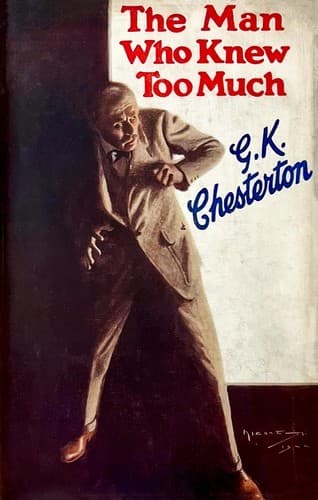
The Man Who Knew Too MuchChesterton, G. K. (Gilbert Keith)
ReligionComparative
The Man Who Knew Too Much
Chesterton, G. K. (Gilbert Keith)
Aristocracy (Social class) -- Fiction; Detective and mystery stories, English; Great Britain -- Fiction
The man was apparently fishing; or at least was fixed in a
fisherman's attitude with more than a fisherman's immobility. March
was able to examine the man almost as if he had been a statue for
some minutes before the statue spoke. He was a tall, fair man,
cadaverous, and a little lackadaisical, with heavy eyelids and a
highbridged nose. When his face was shaded with his wide white hat,
his light mustache and lithe figure gave him a look of youth. But
the Panama lay on the moss beside him; and the spectator could see
that his brow was prematurely bald; and this, combined with a
certain hollowness about the eyes, had an air of headwork and even
headache. But the most curious thing about him, realized after a
short scrutiny, was that, though he looked like a fisherman, he was
not fishing.
He was holding, instead of a rod, something that might have been a
landing-net which some fishermen use, but which was much more like
the ordinary toy net which children carry, and which they generally
use indifferently for shrimps or butterflies. He was dipping this
into the water at intervals, gravely regarding its harvest of weed
or mud, and emptying it out again.
"No, I haven't caught anything," he remarked, calmly, as if
answering an unspoken query. "When I do I have to throw it back
again; especially the big fish. But some of the little beasts
interest me when I get 'em."
"A scientific interest, I suppose?" observed March.
"Of a rather amateurish sort, I fear," answered the strange
fisherman. "I have a sort of hobby about what they call 'phenomena
of phosphorescence.' But it would be rather awkward to go about in
society carrying stinking fish."
"I suppose it would," said March, with a smile.
"Rather odd to enter a drawing-room carrying a large luminous cod,"
continued the stranger, in his listless way. "How quaint it would
be if one could carry it about like a lantern, or have little sprats
for candles. Some of the seabeasts would really be very pretty like
lampshades; the blue sea-snail that glitters all over like
starlight; and some of the red starfish really shine like red stars.
But, naturally, I'm not looking for them here."
March thought of asking him what he was looking for; but, feeling
unequal to a technical discussion at least as deep as the deep-sea
fishes, he returned to more ordinary topics.
"Delightful sort of hole this is," he said. "This little dell and
river here. It's like those places Stevenson talks about, where
something ought to happen."
"I know," answered the other. "I think it's because the place
itself, so to speak, seems to happen and not merely to exist.
Perhaps that's what old Picasso and some of the Cubists are trying
to express by angles and jagged lines. Look at that wall like low
cliffs that juts forward just at right angles to the slope of turf
sweeping up to it. That's like a silent collision. It's like a
breaker and the back-wash of a wave."
Public-domain text, read in full here on John Shaqi.
Reviews
Reviews
No reviews yet
Be the first to share your thoughts on this work.
Join the Discussion
Join the discussion
Sign in to leave a comment or review.
Sign InorCreate an account