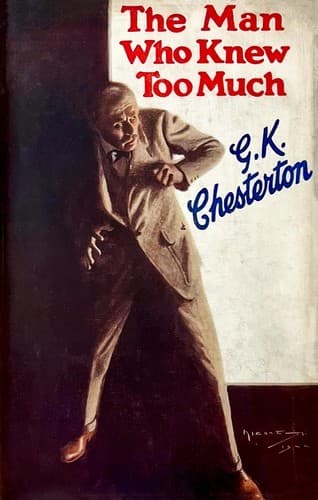
The Man Who Knew Too MuchChesterton, G. K. (Gilbert Keith)
ReligionComparative
The Man Who Knew Too Much
Chesterton, G. K. (Gilbert Keith)
Aristocracy (Social class) -- Fiction; Detective and mystery stories, English; Great Britain -- Fiction
March looked at the low-browed crag overhanging the green slope and
nodded. He was interested in a man who turned so easily from the
technicalities of science to those of art; and asked him if he
admired the new angular artists.
"As I feel it, the Cubists are not Cubist enough," replied the
stranger. "I mean they're not thick enough. By making things
mathematical they make them thin. Take the living lines out of that
landscape, simplify it to a right angle, and you flatten it out to a
mere diagram on paper. Diagrams have their own beauty; but it is of
just the other sort. They stand for the unalterable things; the
calm, eternal, mathematical sort of truths; what somebody calls the
'white radiance of'--"
He stopped, and before the next word came something had happened
almost too quickly and completely to be realized. From behind the
overhanging rock came a noise and rush like that of a railway train;
and a great motor car appeared. It topped the crest of cliff, black
against the sun, like a battle-chariot rushing to destruction in
some wild epic. March automatically put out his hand in one futile
gesture, as if to catch a falling tea-cup in a drawing-room.
For the fraction of a flash it seemed to leave the ledge of rock
like a flying ship; then the very sky seemed to turn over like a
wheel, and it lay a ruin amid the tall grasses below, a line of gray
smoke going up slowly from it into the silent air. A little lower
the figure of a man with gray hair lay tumbled down the steep green
slope, his limbs lying all at random, and his face turned away.
The eccentric fisherman dropped his net and walked swiftly toward
the spot, his new acquaintance following him. As they drew near
there seemed a sort of monstrous irony in the fact that the dead
machine was still throbbing and thundering as busily as a factory,
while the man lay so still.
He was unquestionably dead. The blood flowed in the grass from a
hopelessly fatal fracture at the back of the skull; but the face,
which was turned to the sun, was uninjured and strangely arresting
in itself. It was one of those cases of a strange face so
unmistakable as to feel familiar. We feel, somehow, that we ought to
recognize it, even though we do not. It was of the broad, square
sort with great jaws, almost like that of a highly intellectual ape;
the wide mouth shut so tight as to be traced by a mere line; the
nose short with the sort of nostrils that seem to gape with an
appetite for the air. The oddest thing about the face was that one
of the eyebrows was cocked up at a much sharper angle than the
other. March thought he had never seen a face so naturally alive as
that dead one. And its ugly energy seemed all the stranger for its
halo of hoary hair. Some papers lay half fallen out of the pocket,
and from among them March extracted a card-case. He read the name on
the card aloud.
"Sir Humphrey Turnbull. I'm sure I've heard that name somewhere."
Public-domain text, read in full here on John Shaqi.
Reviews
Reviews
No reviews yet
Be the first to share your thoughts on this work.
Join the Discussion
Join the discussion
Sign in to leave a comment or review.
Sign InorCreate an account