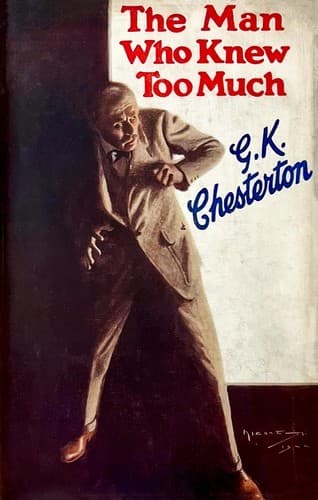
The Man Who Knew Too MuchChesterton, G. K. (Gilbert Keith)
ReligionComparative
The Man Who Knew Too Much
Chesterton, G. K. (Gilbert Keith)
Aristocracy (Social class) -- Fiction; Detective and mystery stories, English; Great Britain -- Fiction
Sir Walter was staring, for he had never seen his rather
lackadaisical young friend look like that before. Fisher was looking
at Wilson with lifted lids, and the eyes under them seemed to have
shed or shifted a film, as do the eyes of an eagle.
"Why are you the officer in charge now?" he asked. "Why can you
conduct the inquiry on your own lines now? How did it come about, I
wonder, that the elder officers are not here to interfere with
anything you do?"
Nobody spoke, and nobody can say how soon anyone would have
collected his wits to speak when a noise came from without. It was
the heavy and hollow sound of a blow upon the door of the tower, and
to their shaken spirits it sounded strangely like the hammer of
doom.
The wooden door of the tower moved on its rusty hinges under the
hand that struck it and Prince Michael came into the room. Nobody
had the smallest doubt about his identity. His light clothes, though
frayed with his adventures, were of fine and almost foppish cut, and
he wore a pointed beard, or imperial, perhaps as a further
reminiscence of Louis Napoleon; but he was a much taller and more
graceful man that his prototype. Before anyone could speak he had
silenced everyone for an instant with a slight but splendid gesture
of hospitality.
"Gentlemen," he said, "this is a poor place now, but you are
heartily welcome."
Wilson was the first to recover, and he took a stride toward the
newcomer.
"Michael O'Neill, I arrest you in the king's name for the murder of
Francis Morton and James Nolan. It is my duty to warn you--"
"No, no, Mr. Wilson," cried Fisher, suddenly. "You shall not commit
a third murder."
Sir Walter Carey rose from his chair, which fell over with a crash
behind him. "What does all this mean?" he called out in an
authoritative manner.
"It means," said Fisher, "that this man, Hooker Wilson, as soon as
he had put his head in at that window, killed his two comrades who
had put their heads in at the other windows, by firing across the
empty room. That is what it means. And if you want to know, count
how many times he is supposed to have fired and then count the
charges left in his revolver."
Wilson, who was still sitting on the table, abruptly put a hand out
for the weapon that lay beside him. But the next movement was the
most unexpected of all, for the prince standing in the doorway
passed suddenly from the dignity of a statue to the swiftness of an
acrobat and rent the revolver out of the detective's hand.
Public-domain text, read in full here on John Shaqi.
Reviews
Reviews
No reviews yet
Be the first to share your thoughts on this work.
Join the Discussion
Join the discussion
Sign in to leave a comment or review.
Sign InorCreate an account