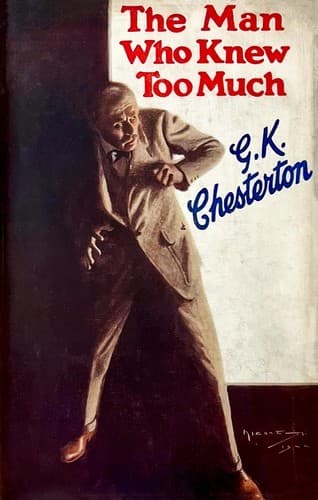
The Man Who Knew Too MuchChesterton, G. K. (Gilbert Keith)
ReligionComparative
The Man Who Knew Too Much
Chesterton, G. K. (Gilbert Keith)
Aristocracy (Social class) -- Fiction; Detective and mystery stories, English; Great Britain -- Fiction
"You dog!" he cried. "So you are the type of English truth, as I am
of Irish tragedy--you who come to kill me, wading through the blood
of your brethren. If they had fallen in a feud on the hillside, it
would be called murder, and yet your sin might be forgiven you. But
I, who am innocent, I was to be slain with ceremony. There would
be long speeches and patient judges listening to my vain plea of
innocence, noting down my despair and disregarding it. Yes, that is
what I call assassination. But killing may be no murder; there is
one shot left in this little gun, and I know where it should go."
Wilson turned quickly on the table, and even as he turned he twisted
in agony, for Michael shot him through the body where he sat, so
that he tumbled off the table like lumber.
The police rushed to lift him; Sir Walter stood speechless; and
then, with a strange and weary gesture, Horne Fisher spoke.
"You are indeed a type of the Irish tragedy," he said. "You were
entirely in the right, and you have put yourself in the wrong."
The prince's face was like marble for a space then there dawned in
his eyes a light not unlike that of despair. He laughed suddenly and
flung the smoking pistol on the ground.
"I am indeed in the wrong," he said. "I have committed a crime that
may justly bring a curse on me and my children."
Horne Fisher did not seem entirely satisfied with this very sudden
repentance; he kept his eyes on the man and only said, in a low
voice, "What crime do you mean?"
"I have helped English justice," replied Prince Michael. "I have
avenged your king's officers; I have done the work of his hangman.
For that truly I deserve to be hanged."
And he turned to the police with a gesture that did not so much
surrender to them, but rather command them to arrest him.
This was the story that Horne Fisher told to Harold March, the
journalist, many years after, in a little, but luxurious, restaurant
near Piccadilly. He had invited March to dinner some time after the
affair he called "The Face in the Target," and the conversation had
naturally turned on that mystery and afterward on earlier memories
of Fisher's life and the way in which he was led to study such
problems as those of Prince Michael. Horne Fisher was fifteen years
older; his thin hair had faded to frontal baldness, and his long,
thin hands dropped less with affectation and more with fatigue. And
he told the story of the Irish adventure of his youth, because it
recorded the first occasion on which he had ever come in contact
with crime, or discovered how darkly and how terribly crime can be
entangled with law.
Public-domain text, read in full here on John Shaqi.
Reviews
Reviews
No reviews yet
Be the first to share your thoughts on this work.
Join the Discussion
Join the discussion
Sign in to leave a comment or review.
Sign InorCreate an account