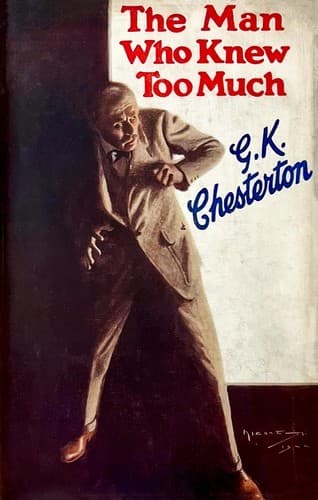
The Man Who Knew Too MuchChesterton, G. K. (Gilbert Keith)
ReligionComparative
The Man Who Knew Too Much
Chesterton, G. K. (Gilbert Keith)
Aristocracy (Social class) -- Fiction; Detective and mystery stories, English; Great Britain -- Fiction
At the entrance their eyes were arrested by a singular figure
evidently hovering there with a similar anxiety to enter. It was
that of a dark, thin man in a long black robe rather like a cassock;
but the black cap on his head was of too strange a shape to be a
biretta. It suggested, rather, some archaic headdress of Persia or
Babylon. He had a curious black beard appearing only at the corners
of his chin, and his large eyes were oddly set in his face like the
flat decorative eyes painted in old Egyptian profiles. Before they
had gathered more than a general impression of him, he had dived
into the doorway that was their own destination.
Nothing could be seen above ground of the sunken sanctuary except a
strong wooden hut, of the sort recently run up for many military and
official purposes, the wooden floor of which was indeed a mere
platform over the excavated cavity below. A soldier stood as a
sentry outside, and a superior soldier, an Anglo-Indian officer of
distinction, sat writing at the desk inside. Indeed, the sightseers
soon found that this particular sight was surrounded with the most
extraordinary precautions. I have compared the silver coin to the
Koh-i-noor, and in one sense it was even conventionally comparable,
since by a historical accident it was at one time almost counted
among the Crown jewels, or at least the Crown relics, until one of
the royal princes publicly restored it to the shrine to which it was
supposed to belong. Other causes combined to concentrate official
vigilance upon it; there had been a scare about spies carrying
explosives in small objects, and one of those experimental orders
which pass like waves over bureaucracy had decreed first that all
visitors should change their clothes for a sort of official
sackcloth, and then (when this method caused some murmurs) that they
should at least turn out their pockets. Colonel Morris, the officer
in charge, was a short, active man with a grim and leathery face,
but a lively and humorous eye--a contradiction borne out by his
conduct, for he at once derided the safeguards and yet insisted on
them.
"I don't care a button myself for Paul's Penny, or such things," he
admitted in answer to some antiquarian openings from the clergyman
who was slightly acquainted with him, "but I wear the King's coat,
you know, and it's a serious thing when the King's uncle leaves a
thing here with his own hands under my charge. But as for saints and
relics and things, I fear I'm a bit of a Voltairian; what you would
call a skeptic."
"I'm not sure it's even skeptical to believe in the royal family and
not in the 'Holy' Family," replied Mr. Twyford. "But, of course, I
can easily empty my pockets, to show I don't carry a bomb."
Public-domain text, read in full here on John Shaqi.
Reviews
Reviews
No reviews yet
Be the first to share your thoughts on this work.
Join the Discussion
Join the discussion
Sign in to leave a comment or review.
Sign InorCreate an account