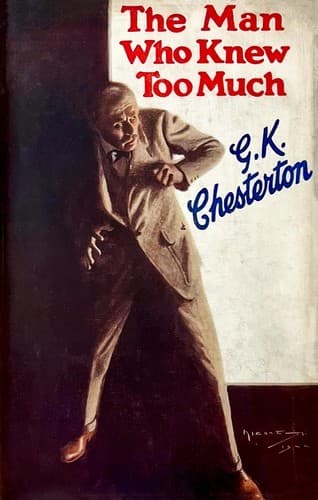
The Man Who Knew Too MuchChesterton, G. K. (Gilbert Keith)
ReligionComparative
The Man Who Knew Too Much
Chesterton, G. K. (Gilbert Keith)
Aristocracy (Social class) -- Fiction; Detective and mystery stories, English; Great Britain -- Fiction
His original purpose had been wholly paternal and festive. But,
like many other intelligent people, he was not above the weakness of
playing with a toy to amuse himself, on the theory that it would
amuse a child. His toys were crowns and miters and croziers and
swords of state; and he had lingered over them, telling himself that
the boy ought to see all the sights of London. And at the end of the
day, after a tremendous tea, he rather gave the game away by winding
up with a visit in which hardly any human boy could be conceived as
taking an interest--an underground chamber supposed to have been a
chapel, recently excavated on the north bank of the Thames, and
containing literally nothing whatever but one old silver coin. But
the coin, to those who knew, was more solitary and splendid than the
Koh-i-noor. It was Roman, and was said to bear the head of St. Paul;
and round it raged the most vital controversies about the ancient
British Church. It could hardly be denied, however, that the
controversies left Summers Minor comparatively cold.
Indeed, the things that interested Summers Minor, and the things
that did not interest him, had mystified and amused his uncle for
several hours. He exhibited the English schoolboy's startling
ignorance and startling knowledge--knowledge of some special
classification in which he can generally correct and confound his
elders. He considered himself entitled, at Hampton Court on a
holiday, to forget the very names of Cardinal Wolsey or William of
Orange; but he could hardly be dragged from some details about the
arrangement of the electric bells in the neighboring hotel. He was
solidly dazed by Westminster Abbey, which is not so unnatural since
that church became the lumber room of the larger and less successful
statuary of the eighteenth century. But he had a magic and minute
knowledge of the Westminster omnibuses, and indeed of the whole
omnibus system of London, the colors and numbers of which he knew as
a herald knows heraldry. He would cry out against a momentary
confusion between a light-green Paddington and a dark-green
Bayswater vehicle, as his uncle would at the identification of a
Greek ikon and a Roman image.
"Do you collect omnibuses like stamps?" asked his uncle. "They must
need a rather large album. Or do you keep them in your locker?"
"I keep them in my head," replied the nephew, with legitimate
firmness.
"It does you credit, I admit," replied the clergyman. "I suppose it
were vain to ask for what purpose you have learned that out of a
thousand things. There hardly seems to be a career in it, unless you
could be permanently on the pavement to prevent old ladies getting
into the wrong bus. Well, we must get out of this one, for this is
our place. I want to show you what they call St. Paul's Penny."
"Is it like St. Paul's Cathedral?" asked the youth with resignation,
as they alighted.
Public-domain text, read in full here on John Shaqi.
Reviews
Reviews
No reviews yet
Be the first to share your thoughts on this work.
Join the Discussion
Join the discussion
Sign in to leave a comment or review.
Sign InorCreate an account