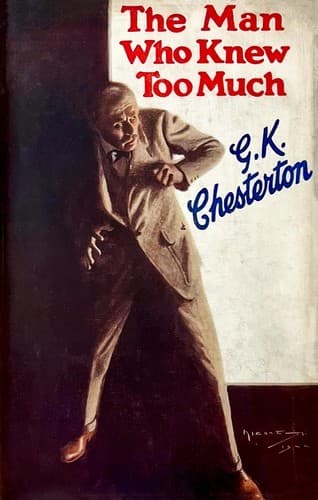
The Man Who Knew Too MuchChesterton, G. K. (Gilbert Keith)
ReligionComparative
The Man Who Knew Too Much
Chesterton, G. K. (Gilbert Keith)
Aristocracy (Social class) -- Fiction; Detective and mystery stories, English; Great Britain -- Fiction
"Here comes Colonel Morris," went on Twyford, still speaking to
Symon. "One of us will have to tell him how the light went out. Will
you?"
But Symon still said nothing. He was standing as still as a statue,
and looking steadily at the black velvet behind the glass screen. He
was looking at the black velvet because there was nothing else to
look at. St. Paul's Penny was gone.
Colonel Morris entered the room with two new visitors; presumably
two new sightseers delayed by the accident. The foremost was a tall,
fair, rather languid-looking man with a bald brow and a high-bridged
nose; his companion was a younger man with light, curly hair and
frank, and even innocent, eyes. Symon scarcely seemed to hear the
newcomers; it seemed almost as if he had not realized that the
return of the light revealed his brooding attitude. Then he started
in a guilty fashion, and when he saw the elder of the two strangers,
his pale face seemed to turn a shade paler.
"Why it's Horne Fisher!" and then after a pause he said in a low
voice, "I'm in the devil of a hole, Fisher."
"There does seem a bit of a mystery to be cleared up," observed the
gentleman so addressed.
"It will never be cleared up," said the pale Symon. "If anybody
could clear it up, you could. But nobody could."
"I rather think I could," said another voice from outside the group,
and they turned in surprise to realize that the man in the black
robe had spoken again.
"You!" said the colonel, sharply. "And how do you propose to play
the detective?"
"I do not propose to play the detective," answered the other, in a
clear voice like a bell. "I propose to play the magician. One of the
magicians you show up in India, Colonel."
No one spoke for a moment, and then Horne Fisher surprised everybody
by saying, "Well, let's go upstairs, and this gentleman can have a
try."
He stopped Symon, who had an automatic finger on the button, saying:
"No, leave all the lights on. It's a sort of safeguard."
"The thing can't be taken away now," said Symon, bitterly.
"It can be put back," replied Fisher.
Twyford had already run upstairs for news of his vanishing nephew,
and he received news of him in a way that at once puzzled and
reassured him. On the floor above lay one of those large paper darts
which boys throw at each other when the schoolmaster is out of the
room. It had evidently been thrown in at the window, and on being
unfolded displayed a scrawl of bad handwriting which ran: "Dear
Uncle; I am all right. Meet you at the hotel later on," and then the
signature.
Public-domain text, read in full here on John Shaqi.
Reviews
Reviews
No reviews yet
Be the first to share your thoughts on this work.
Join the Discussion
Join the discussion
Sign in to leave a comment or review.
Sign InorCreate an account