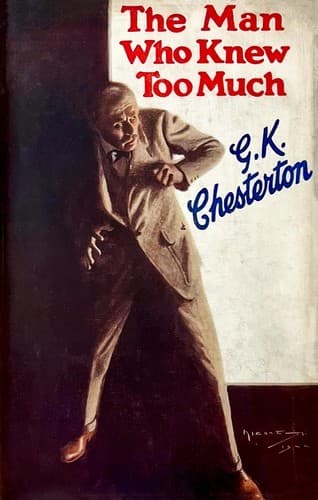
The Man Who Knew Too MuchChesterton, G. K. (Gilbert Keith)
ReligionComparative
The Man Who Knew Too Much
Chesterton, G. K. (Gilbert Keith)
Aristocracy (Social class) -- Fiction; Detective and mystery stories, English; Great Britain -- Fiction
Insensibly comforted by this, the clergyman found his thoughts
reverting voluntarily to his favorite relic, which came a good
second in his sympathies to his favorite nephew, and before he knew
where he was he found himself encircled by the group discussing its
loss, and more or less carried away on the current of their
excitement. But an undercurrent of query continued to run in his
mind, as to what had really happened to the boy, and what was the
boy's exact definition of being all right.
Meanwhile Horne Fisher had considerably puzzled everybody with his
new tone and attitude. He had talked to the colonel about the
military and mechanical arrangements, and displayed a remarkable
knowledge both of the details of discipline and the technicalities
of electricity. He had talked to the clergyman, and shown an equally
surprising knowledge of the religious and historical interests
involved in the relic. He had talked to the man who called himself a
magician, and not only surprised but scandalized the company by an
equally sympathetic familiarity with the most fantastic forms of
Oriental occultism and psychic experiment. And in this last and
least respectable line of inquiry he was evidently prepared to go
farthest; he openly encouraged the magician, and was plainly
prepared to follow the wildest ways of investigation in which that
magus might lead him.
"How would you begin now?" he inquired, with an anxious politeness
that reduced the colonel to a congestion of rage.
"It is all a question of a force; of establishing communications for
a force," replied that adept, affably, ignoring some military
mutterings about the police force. "It is what you in the West used
to call animal magnetism, but it is much more than that. I had
better not say how much more. As to setting about it, the usual
method is to throw some susceptible person into a trance, which
serves as a sort of bridge or cord of communication, by which the
force beyond can give him, as it were, an electric shock, and awaken
his higher senses. It opens the sleeping eye of the mind."
"I'm suspectible," said Fisher, either with simplicity or with a
baffling irony. "Why not open my mind's eye for me? My friend Harold
March here will tell you I sometimes see things, even in the dark."
"Nobody sees anything except in the dark," said the magician.
Heavy clouds of sunset were closing round the wooden hut, enormous
clouds, of which only the corners could be seen in the little
window, like purple horns and tails, almost as if some huge monsters
were prowling round the place. But the purple was already deepening
to dark gray; it would soon be night.
"Do not light the lamp," said the magus with quiet authority,
arresting a movement in that direction. "I told you before that
things happen only in the dark."
Public-domain text, read in full here on John Shaqi.
Reviews
Reviews
No reviews yet
Be the first to share your thoughts on this work.
Join the Discussion
Join the discussion
Sign in to leave a comment or review.
Sign InorCreate an account