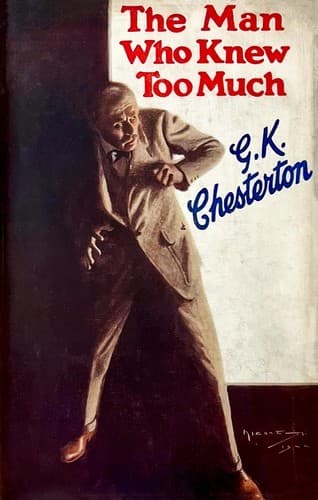
The Man Who Knew Too MuchChesterton, G. K. (Gilbert Keith)
ReligionComparative
The Man Who Knew Too Much
Chesterton, G. K. (Gilbert Keith)
Aristocracy (Social class) -- Fiction; Detective and mystery stories, English; Great Britain -- Fiction
His companion only gave a sort of a little sigh and was silent for a
moment, as if ruminating, then he merely said, "The poor fellow is
quite gone," and added some scientific terms in which his auditor
once more found himself out of his depth.
"As things are," continued the same curiously well-informed person,
"it will be more legal for us to leave the body as it is until the
police are informed. In fact, I think it will be well if nobody
except the police is informed. Don't be surprised if I seem to be
keeping it dark from some of our neighbors round here." Then, as if
prompted to regularize his rather abrupt confidence, he said: "I've
come down to see my cousin at Torwood; my name is Horne Fisher.
Might be a pun on my pottering about here, mightn't it?"
"Is Sir Howard Horne your cousin?" asked March. "I'm going to
Torwood Park to see him myself; only about his public work, of
course, and the wonderful stand he is making for his principles. I
think this Budget is the greatest thing in English history. If it
fails, it will be the most heroic failure in English history. Are
you an admirer of your great kinsman, Mr. Fisher?"
"Rather," said Mr. Fisher. "He's the best shot I know."
Then, as if sincerely repentant of his nonchalance, he added, with a
sort of enthusiasm:
"No, but really, he's a _beautiful_ shot."
As if fired by his own words, he took a sort of leap at the ledges
of the rock above him, and scaled them with a sudden agility in
startling contrast to his general lassitude. He had stood for some
seconds on the headland above, with his aquiline profile under the
Panama hat relieved against the sky and peering over the countryside
before his companion had collected himself sufficiently to scramble
up after him.
The level above was a stretch of common turf on which the tracks of
the fated car were plowed plainly enough; but the brink of it was
broken as with rocky teeth; broken boulders of all shapes and sizes
lay near the edge; it was almost incredible that any one could have
deliberately driven into such a death trap, especially in broad
daylight.
"I can't make head or tail of it," said March. "Was he blind? Or
blind drunk?"
"Neither, by the look of him," replied the other.
"Then it was suicide."
"It doesn't seem a cozy way of doing it," remarked the man called
Fisher. "Besides, I don't fancy poor old Puggy would commit suicide,
somehow."
"Poor old who?" inquired the wondering journalist. "Did you know
this unfortunate man?"
Public-domain text, read in full here on John Shaqi.
Reviews
Reviews
No reviews yet
Be the first to share your thoughts on this work.
Join the Discussion
Join the discussion
Sign in to leave a comment or review.
Sign InorCreate an account