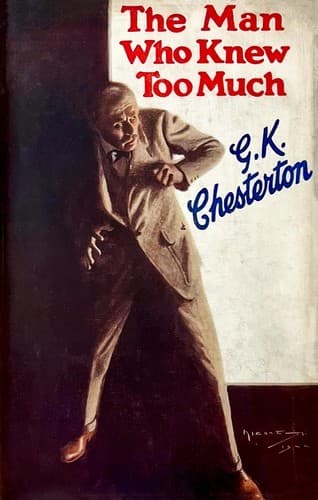
The Man Who Knew Too MuchChesterton, G. K. (Gilbert Keith)
ReligionComparative
The Man Who Knew Too Much
Chesterton, G. K. (Gilbert Keith)
Aristocracy (Social class) -- Fiction; Detective and mystery stories, English; Great Britain -- Fiction
"I thought you meant to catch him in his own trap," said Twyford.
"I can't make head or tail of anything yet, but to my mind he was
always the suspect. I don't think he was necessarily a thief in the
vulgar sense. The police always seem to think that silver is stolen
for the sake of silver, but a thing like that might well be stolen
out of some religious mania. A runaway monk turned mystic might well
want it for some mystical purpose."
"No," replied Fisher, "the runaway monk is not a thief. At any rate
he is not the thief. And he's not altogether a liar, either. He said
one true thing at least that night."
"And what was that?" inquired March.
"He said it was all magnetism. As a matter of fact, it was done by
means of a magnet." Then, seeing they still looked puzzled, he
added, "It was that toy magnet belonging to your nephew, Mr.
Twyford."
"But I don't understand," objected March. "If it was done with the
schoolboy's magnet, I suppose it was done by the schoolboy."
"Well," replied Fisher, reflectively, "it rather depends which
schoolboy."
"What on earth do you mean?"
"The soul of a schoolboy is a curious thing," Fisher continued, in a
meditative manner. "It can survive a great many things besides
climbing out of a chimney. A man can grow gray in great campaigns,
and still have the soul of a schoolboy. A man can return with a
great reputation from India and be put in charge of a great public
treasure, and still have the soul of a schoolboy, waiting to be
awakened by an accident. And it is ten times more so when to the
schoolboy you add the skeptic, who is generally a sort of stunted
schoolboy. You said just now that things might be done by religious
mania. Have you ever heard of irreligious mania? I assure you it
exists very violently, especially in men who like showing up
magicians in India. But here the skeptic had the temptation of
showing up a much more tremendous sham nearer home."
A light came into Harold March's eyes as he suddenly saw, as if afar
off, the wider implication of the suggestion. But Twyford was still
wrestling with one problem at a time.
"Do you really mean," he said, "that Colonel Morris took the relic?"
"He was the only person who could use the magnet," replied Fisher.
"In fact, your obliging nephew left him a number of things he could
use. He had a ball of string, and an instrument for making a hole in
the wooden floor--I made a little play with that hole in the floor
in my trance, by the way; with the lights left on below, it shone
like a new shilling." Twyford suddenly bounded on his chair. "But in
that case," he cried, in a new and altered voice, "why then of
course-- You said a piece of steel--?"
"I said there were two pieces of steel," said Fisher. "The bent
piece of steel was the boy's magnet. The other was the relic in the
glass case."
"But that is silver," answered the archaeologist, in a voice now
almost unrecognizable.
Public-domain text, read in full here on John Shaqi.
Reviews
Reviews
No reviews yet
Be the first to share your thoughts on this work.
Join the Discussion
Join the discussion
Sign in to leave a comment or review.
Sign InorCreate an account