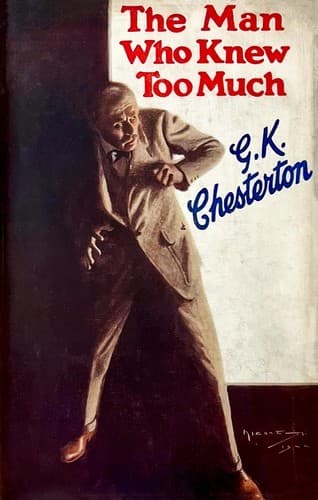
The Man Who Knew Too MuchChesterton, G. K. (Gilbert Keith)
ReligionComparative
The Man Who Knew Too Much
Chesterton, G. K. (Gilbert Keith)
Aristocracy (Social class) -- Fiction; Detective and mystery stories, English; Great Britain -- Fiction
How such a topsy-turvy scene ever came to be tolerated in the
colonel's office, of all places, was afterward a puzzle in the
memory of many, including the colonel. They recalled it like a sort
of nightmare, like something they could not control. Perhaps there
was really a magnetism about the mesmerist; perhaps there was even
more magnetism about the man mesmerized. Anyhow, the man was being
mesmerized, for Horne Fisher had collapsed into a chair with his
long limbs loose and sprawling and his eyes staring at vacancy; and
the other man was mesmerizing him, making sweeping movements with
his darkly draped arms as if with black wings. The colonel had
passed the point of explosion, and he dimly realized that eccentric
aristocrats are allowed their fling. He comforted himself with the
knowledge that he had already sent for the police, who would break
up any such masquerade, and with lighting a cigar, the red end of
which, in the gathering darkness, glowed with protest.
"Yes, I see pockets," the man in the trance was saying. "I see many
pockets, but they are all empty. No; I see one pocket that is not
empty."
There was a faint stir in the stillness, and the magician said, "Can
you see what is in the pocket?"
"Yes," answered the other; "there are two bright things. I think
they are two bits of steel. One of the pieces of steel is bent or
crooked."
"Have they been used in the removal of the relic from downstairs?"
"Yes."
There was another pause and the inquirer added, "Do you see anything
of the relic itself?"
"I see something shining on the floor, like the shadow or the ghost
of it. It is over there in the corner beyond the desk."
There was a movement of men turning and then a sudden stillness, as
of their stiffening, for over in the corner on the wooden floor
there was really a round spot of pale light. It was the only spot of
light in the room. The cigar had gone out.
"It points the way," came the voice of the oracle. "The spirits are
pointing the way to penitence, and urging the thief to restitution.
I can see nothing more." His voice trailed off into a silence that
lasted solidly for many minutes, like the long silence below when
the theft had been committed. Then it was broken by the ring of
metal on the floor, and the sound of something spinning and falling
like a tossed halfpenny.
"Light the lamp!" cried Fisher in a loud and even jovial voice,
leaping to his feet with far less languor than usual. "I must be
going now, but I should like to see it before I go. Why, I came on
purpose to see it."
The lamp was lit, and he did see it, for St. Paul's Penny was lying
on the floor at his feet.
"Oh, as for that," explained Fisher, when he was entertaining March
and Twyford at lunch about a month later, "I merely wanted to play
with the magician at his own game."
Public-domain text, read in full here on John Shaqi.
Reviews
Reviews
No reviews yet
Be the first to share your thoughts on this work.
Join the Discussion
Join the discussion
Sign in to leave a comment or review.
Sign InorCreate an account