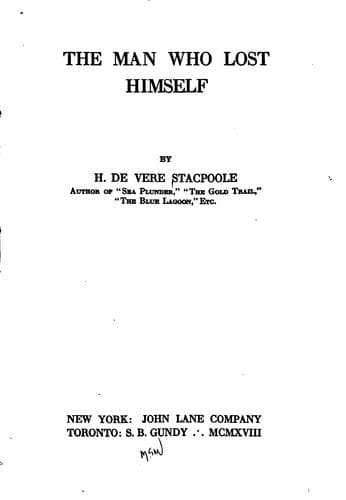
The Man Who Lost HimselfStacpoole, H. De Vere (Henry De Vere)
General
The Man Who Lost Himself
Stacpoole, H. De Vere (Henry De Vere)
Mistaken identity -- Fiction
He opened the door and entered, walking between the tables and looking
the luncheon parties in the face.
The man seated has a tremendous advantage over the man standing in this
sort of game. One or two of the members met by the newcomer's glance,
bowed in the curious manner of the seated Briton, the eyes of others
fell away, others nodded frigidly, it seemed to Jones. Then, like a
pilot fish before a shark leading him to his food, a club waiter
developed and piloted him to a small unoccupied table, where he took a
seat and looked at a menu handed to him by the pilot.
He ordered fillet of sole, roast chicken, salad, and strawberry ice.
They were the easiest things to order. He would have ordered roast
elephant's trunk had it been easier and on the menu.
A man after the storming of Hell Gate, or just dismounted after the
Charge of the Light Brigade, would have possessed as little instinct for
menu hunting as Jones.
He had pierced the ranks of the British Aristocracy; that was
nothing--he was seated at their camp fire, sharing their food, and they
were all inimical towards him; that was everything.
He felt the draught. He felt that these men had a down on him; felt it
by all sorts of senses that seemed newly developed. Not a down on him,
Jones, but a down on him, Rochester, Arthur Coningsby Delamere, 21st
Earl of.
And the extraordinary thing was that he felt it. What on earth did it
matter to him if these men looked coldly upon another man? It did. It
mattered quite a lot, more than perhaps it ever mattered to the other
man. Is the soul such a shallow and blind thing that it cannot sort the
true from the false, the material from the immaterial, cannot see that
an insult levelled at a likeness is not an insult levelled at _it_?
Surely not, and yet the soul of Victor Jones resented the coolness of
others towards the supposed body of Rochester, as though it were a
personal insult.
It was the first intimation to Jones that when the actor puts on his
part he puts on more than a cloak or trunk hose, that the personality he
had put on had nerves curiously associated with his own nerves, and
that, though he might say to himself a hundred times with respect to the
attitudes of other people, "Pah! they don't mean me," that formula was
no charm against disdain.
The wine butler, a gentleman not unlike Mr. Church, was now at his
elbow, and he found himself contemplating the wine card of the Senior
Conservative, a serious document, if one may judge by the faces of the
men who peruse it.
It is in fact the Almanach de Gotha of wines. The old kings of wine are
here, the princess and all the aristocracy. Unlike the Almanach de
Gotha, however, the price of each is set down. Unlike the Almanach de
Gotha, the names of a few commoners are admitted.
Macon was here, and even Blackways' Cyder, the favourite tipple of the
old Duke of Taunton.
Jones ran his eye over the list without enthusiasm. He had taken a
dislike to alcohol even in its mildest guise.
Public-domain text, read in full here on John Shaqi.
Reviews
Reviews
No reviews yet
Be the first to share your thoughts on this work.
Join the Discussion
Join the discussion
Sign in to leave a comment or review.
Sign InorCreate an account