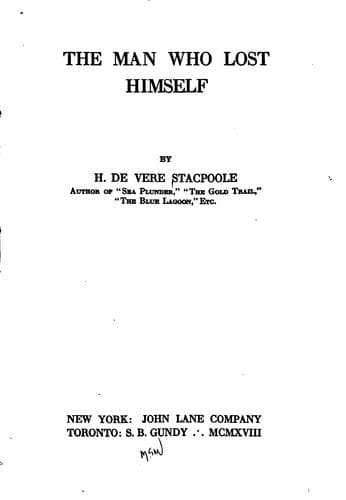
The Man Who Lost HimselfStacpoole, H. De Vere (Henry De Vere)
General
The Man Who Lost Himself
Stacpoole, H. De Vere (Henry De Vere)
Mistaken identity -- Fiction
"Er--what minerals have you got?" asked he.
"Minerals!"
The man with the wine card was nonplussed. Jones saw his mistake.
"Soda water," said he. "Get me some soda water."
The fillet of sole with sauce Tartare was excellent. Nothing, not even
the minerals could dim that fact. As he ate he looked about him, and
with all the more ease, because he found now that nobody was looking at
him; his self consciousness died down, and he began speculating on the
men around, their probable rank, fortune, and intellect. It seemed to
Jones that the latter factor was easier of determination than the other
two.
What struck him more forcibly was a weird resemblance between them all,
a phantom thing, a link undiscoverable yet somehow there. This tribal
expression is one of the strangest phenomena eternally comforting and
battering our senses.
Just as men grow like their wives, so do they grow like their fellow
tradesmen, waiters like waiters, grooms like grooms, lawyers like
lawyers, politicians like politicians. More, it has been undeniably
proved that landowners grow like landowners, just as shepherds grow like
sheep, and aristocrats like aristocrats.
A common idea moulds faces to its shape, and a common want of ideas
allows external circumstances to do the moulding.
So, English Conservative Politicians of the higher order, being worked
upon by external circumstances of a similar nature, have perhaps a
certain similar expression. Radical Politicians on the other hand, shape
to a common idea--evil--but still an idea. Jones was not thinking this,
he was just recognising that all these men belonged to the same class,
and he felt in himself that, not only did he not belong to that class,
but that Rochester also, probably, had found himself in the same
position.
That might have accounted for the wildness and eccentricity of
Rochester, as demonstrated in that mad carouse and hinted at by the
woman in the feather boa. The wildness of a monkey condemned to live
amongst goats, hanging on to their horns, and clutching at their scuts,
and playing all the tricks that contrariness might suggest to a contrary
nature.
Something of this sort was passing through Jones' mind, and as he
attacked his strawberry ice, for the first time since reading that
momentous piece of news in the evening newspaper his mental powers
became focussed on the question that lay at the very heart of all this
business. It struck him now so very forcibly that he laid down his spoon
and stared before him, forgetful of the place where he was and the
people around him.
"Why did that guy commit suicide?"
That was the question.
He could find no answer to it.
Public-domain text, read in full here on John Shaqi.
Reviews
Reviews
No reviews yet
Be the first to share your thoughts on this work.
Join the Discussion
Join the discussion
Sign in to leave a comment or review.
Sign InorCreate an account