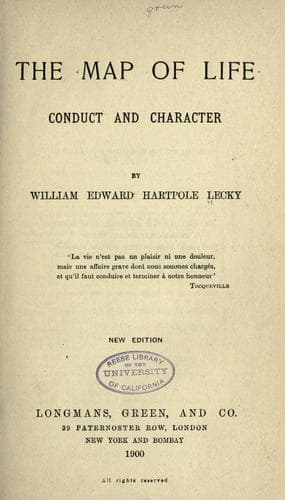
The Map of Life: Conduct and CharacterLecky, William Edward Hartpole
Philosophy
The Map of Life: Conduct and Character
Lecky, William Edward Hartpole
Character; Conduct of life
One of the first questions that must naturally occur to every writer who
deals with the subject of this book is, what influence mere discussion
and reasoning can have in promoting the happiness of men. The
circumstances of our lives and the dispositions of our characters mainly
determine the measure of happiness we enjoy, and mere argument about the
causes of happiness and unhappiness can do little to affect them. It is
impossible to read the many books that have been written on these
subjects without feeling how largely they consist of mere sounding
generalities which the smallest experience shows to be perfectly
impotent in the face of some real and acute sorrow, and it is equally
impossible to obtain any serious knowledge of the world without
perceiving that a large proportion of the happiest lives and characters
are to be found where introspection, self-analysis and reasonings about
the good and evil of life hold the smallest place. Happiness, indeed,
like health, is one of the things of which men rarely think except when
it is impaired, and much that has been written on the subject has been
written under the stress of some great depression. Such writers are
like the man in Hogarth's picture occupying himself in the debtors'
prison with plans for the payment of the National Debt. There are
moments when all of us feel the force of the words of Voltaire:
'Travaillons sans raisonner, c'est le seul moyen de rendre la vie
supportable.'
That there is much truth in such considerations is incontestable, and it
is only within a restricted sphere that the province of reasoning
extends. Man comes into the world with mental and moral characteristics
which he can only very imperfectly influence, and a large proportion of
the external circumstances of his life lie wholly or mainly beyond his
control. At the same time, every one recognises the power of skill,
industry and perseverance to modify surrounding circumstances; the power
of temperance and prudence to strengthen a naturally weak constitution,
prolong life, and diminish the chances of disease; the power of
education and private study to develop, sharpen and employ to the best
advantage our intellectual faculties. Every one also recognises how
large a part of the unhappiness of most men may be directly traced to
their own voluntary and deliberate acts. The power each man possesses in
the education and management of his character, and especially in the
cultivation of the dispositions and tendencies which most largely
contribute to happiness, is less recognised and is perhaps less
extensive, but it is not less real.
Public-domain text, read in full here on John Shaqi.
Reviews
Reviews
No reviews yet
Be the first to share your thoughts on this work.
Join the Discussion
Join the discussion
Sign in to leave a comment or review.
Sign InorCreate an account