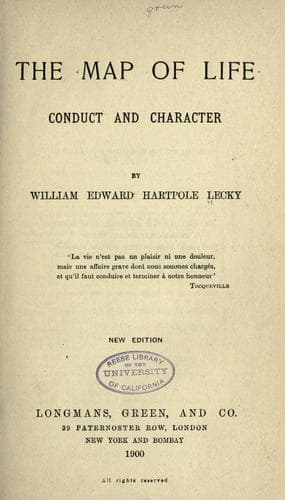
The Map of Life: Conduct and CharacterLecky, William Edward Hartpole
Philosophy
The Map of Life: Conduct and Character
Lecky, William Edward Hartpole
Character; Conduct of life
The eternal question of free will and determinism here naturally meets
us, but on such a subject it is idle to suppose that a modern writer can
do more than define the question and state his own side. The
Determinist says that the real question is not whether a man can do
what he desires, but whether he can do what he does not desire; whether
the will can act without a motive; whether that motive can in the last
analysis be other than the strongest pleasure. The illusion of free
will, he maintains, is only due to the conflict of our motives. Under
many forms and disguises pleasure and pain have an absolute empire over
conduct. The will is nothing more than the last and strongest desire; or
it is like a piece of iron surrounded by magnets and necessarily drawn
by the most powerful; or (as has been ingeniously imagined) like a
weathercock, conscious of its own motion, but not conscious of the winds
that are moving it. The law of compulsory causation applies to the world
of mind as truly as to the world of matter. Heredity and Circumstance
make us what we are. Our actions are the inevitable result of the mental
and moral constitutions with which we came into the world, operated on
by external influences.
The supporters of free will, on the other hand, maintain that it is a
fact of consciousness that there is a clear distinction between the Will
and the Desires, and that although they are closely connected no sound
analysis will confuse them. Coleridge ingeniously compared their
relations to 'the co-instantaneous yet reciprocal action of the air and
the vital energy of the lungs in breathing.'[1] If the will is
powerfully acted on by the desires, it has also in its turn a power of
acting upon them, and it is not a mere slave to pleasure and pain. The
supporters of this view maintain that it is a fact of the plainest
consciousness that we can do things which we do not like; that we can
suspend the force of imperious desires, resist the bias of our nature,
pursue for the sake of duty the course which gives least pleasure
without deriving or expecting from it any pleasure, and select at a
given moment between alternate courses. They maintain that when various
motives pass before the mind, the mind retains a power of choosing and
judging, of accepting and rejecting; that it can by force of reason or
by force of imagination bring one motive into prominence, concentrating
its attention on it and thus intensifying its power; that it has a
corresponding power of resisting other motives, driving them into the
background and thus gradually diminishing their force; that the will
itself becomes stronger by exercise, as the desires do by indulgence.
The conflict between the will and the desires, the reality of
self-restraint and the power of Will to modify character, are among the
most familiar facts of moral life. In the words of Burke, 'It is the
prerogative of man to be in a great degree a creature of his own
Public-domain text, read in full here on John Shaqi.
Reviews
Reviews
No reviews yet
Be the first to share your thoughts on this work.
Join the Discussion
Join the discussion
Sign in to leave a comment or review.
Sign InorCreate an account