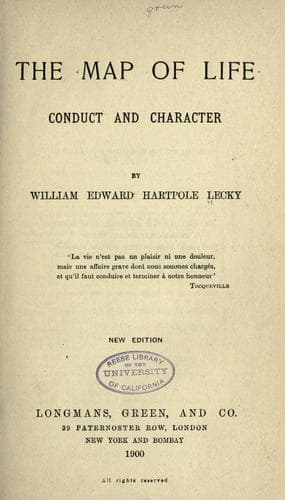
The Map of Life: Conduct and CharacterLecky, William Edward Hartpole
Philosophy
The Map of Life: Conduct and Character
Lecky, William Edward Hartpole
Character; Conduct of life
to reassemble, was so organised and shackled that every vestige of free
discussion for many years disappeared, and a despotism of almost
Asiatic severity was established in France.
It may be fully conceded that the tragedy of December 4, when for more
than a quarter of an hour some 3,000 French soldiers deliberately fired
volley after volley without return upon the unoffending spectators on
the Boulevards, broke into the houses and killed multitudes, not only of
men but of women and children, till the Boulevards, in the words of an
English eye-witness, were 'at some points a perfect shambles,' and the
blood lay in pools round the trees that fringed them, was not ordered by
the President, though it remained absolutely unpunished and uncensured
by him. There is conflicting evidence on this point, but it is probable
that some stray shots had been fired from the houses, and it is certain
that a wild and sanguinary panic had fallen upon the soldiers. It is
possible too, and not improbable, that the stories so generally believed
in Paris that large batches of prisoners, who had been arrested, were
brought out of prison in the dead hours of the night and deliberately
shot by bodies of soldiers, may have been exaggerated or untrue. Maupas,
who was Préfet of Police, and who must have known the truth, positively
denied it; but the question what credence should be attached to a man of
his antecedents who boasted that he had been from the first a leading
agent in the whole conspiracy may be reasonably asked.[46] Evidence of
these things, as has been truly said, could scarcely be obtained, for
the press was absolutely gagged and all possibility of investigation was
prevented. For the number of those who were transported or forcibly
expelled within the few weeks after December 2, we may perhaps rely upon
the historian and panegyrist of the Empire. He computes them at the
enormous number of 26,500.[47] After the Plébiscite new measures of
proscription were taken, and, according to Émile Ollivier, one of the
most enthusiastic and skilful eulogists of the _Coup d'état_, in the
first months of 1852 there were from 15,000 to 20,000 political
prisoners in the French prisons.[48] It was by such means that Louis
Napoleon attained the empire which had been the dream of his life.
Public-domain text, read in full here on John Shaqi.
Reviews
Reviews
No reviews yet
Be the first to share your thoughts on this work.
Elsewhere in the archive
Join the Discussion
Join the discussion
Sign in to leave a comment or review.
Sign InorCreate an account