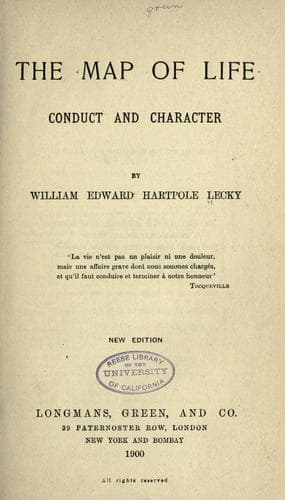
The Map of Life: Conduct and CharacterLecky, William Edward Hartpole
Philosophy
The Map of Life: Conduct and Character
Lecky, William Edward Hartpole
Character; Conduct of life
These two distinct schools, however, have subsisted in the Church. Each
of them can find some support in the Prayer-book, and the old orthodox
High Church school which was chiefly elaborated and which chiefly
flourished under the Stuarts, has produced a great part of the most
learned theology of Christendom, and had in its early days little or no
tendency to Rome. It was exclusive and repellent on the side of
Nonconformity, and it placed Church authority very high; but the immense
majority of its members were intensely loyal to the Anglican Church, and
lived and died contentedly within its pale. There were, however, always
in that Church men of another kind whose true ideal lay beyond its
border. Falkland, in a remarkable speech, delivered in 1640, speaks of
them with much bitterness. 'Some,' he says, 'have so industriously
laboured to deduce themselves from Rome that they have given great
suspicion that in gratitude they desire to return thither, or at least
to meet it half way. Some have evidently laboured to bring in an English
though not a Roman Popery; I mean not only the outside and dress of it,
but equally absolute.... Nay, common fame is more than ordinarily false
if none of them have found a way to reconcile the opinions of Rome to
the preferments of England, and be so absolutely, directly and cordially
Papists that it is all that 1,500_l._ a year can do to keep them from
confessing it.'[59]
No wide secession to Rome, however, followed the development of this
seventeenth-century school, though it played a large part in the
nonjuror schism, and with the decay of that schism and under the
latitudinarian tendencies of the eighteenth century it greatly dwindled.
Since, however, the Tractarian movement, which carried so many leaders
of the English Church to Rome, men of Roman sympathies and Roman ideals
have multiplied within the Church to an extraordinary degree. They have
not only carried their theological pretensions in the direction of Rome
much further than the nonjurors; they have also in many cases so
transformed the old and simple Anglican service by vestments and
candles, and banners and incense, and genuflexions and whispered
prayers, that a stranger might well imagine that he was in a Roman
Catholic church. They have put forward sacerdotal pretensions little, if
at all, inferior to those of Rome. The whole tendency of their
devotional literature and thought flows in the Roman channel, and even
in the most insignificant matters of ceremony and dress they are
accustomed to pay the greater Church the homage of constant imitation.
Public-domain text, read in full here on John Shaqi.
Reviews
Reviews
No reviews yet
Be the first to share your thoughts on this work.
Elsewhere in the archive
Join the Discussion
Join the discussion
Sign in to leave a comment or review.
Sign InorCreate an account