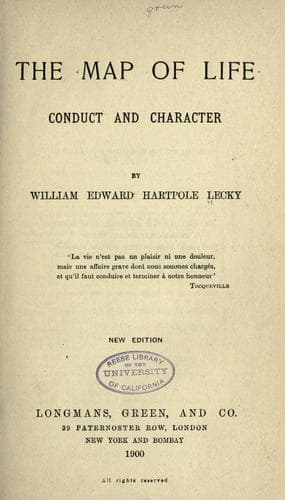
The Map of Life: Conduct and CharacterLecky, William Edward Hartpole
Philosophy
The Map of Life: Conduct and Character
Lecky, William Edward Hartpole
Character; Conduct of life
It would be unjust to deny that there are some real differences. The
absolute authority and infallibility of the Pope are sincerely
repudiated as an usurpation, the ritualist theory only conceding to him
a primacy among bishops. The discipline and submission to ecclesiastical
authority also, which so eminently distinguish the Roman Church, are
wholly wanting in many of its Anglican imitators, and at the same time
the English sense of truth has proved sufficient to save the party from
the tolerance and propagation of false miracles and of grossly
superstitious practices so common in Roman Catholic countries. In this
last respect, however, it is probable that English and American Roman
Catholics are almost equally distinguished from Catholics in the
Southern States of Europe and of America. Still, when all this is
admitted, it can hardly be denied that there has grown up in a great
section of the English Church a sympathy with Rome and an antipathy to
Protestantism and to Protestant types of thought and character utterly
alien to the spirit of the Reformers and to the doctrinal formularies of
the Church of England.
It is not very easy to form a just estimate of the extent and depth of
this movement. There are wide variations in the High Church party; the
extreme men are not the most numerous and certainly very far from the
ablest, and many influences other than convinced belief have tended to
strengthen the party. It has been, indeed, unlike the Tractarian party
which preceded it, remarkably destitute of literary or theological
ability, and has added singularly little to the large and noble
theological literature of the English Church. The mere charm of novelty,
which is always especially powerful in the field of religion, draws many
to the ritualistic channel, and thousands who care very little for
ritualistic doctrines are attracted by the music, the pageantry, the
pictorial beauty of the ritualistic services. Æsthetic tastes have of
late years greatly increased in England, and the closing of places of
amusement on Sunday probably strengthens the craving for more attractive
services. The extreme High Church party has chiefly fostered and chiefly
benefited by this desire, but it has extended much more widely. It has
touched even puritanical and non-episcopal bodies, and it is sometimes
combined with extremely latitudinarian opinions. There is, indeed, a
type of mind which finds in such services a happy anodyne for
half-suppressed doubt. Petitions which in their poignant humiliation and
profound emotion no longer correspond to the genuine feelings of the
worshipper, seem attenuated and transformed when they are intoned, and
creeds which when plainly read shock the understanding and the
conscience are readily accepted as parts of a musical performance.
Scepticism as well as belief sometimes fills churches. Large classes who
have no wish to cut themselves off from religious services have lost all
Public-domain text, read in full here on John Shaqi.
Reviews
Reviews
No reviews yet
Be the first to share your thoughts on this work.
Elsewhere in the archive
Join the Discussion
Join the discussion
Sign in to leave a comment or review.
Sign InorCreate an account