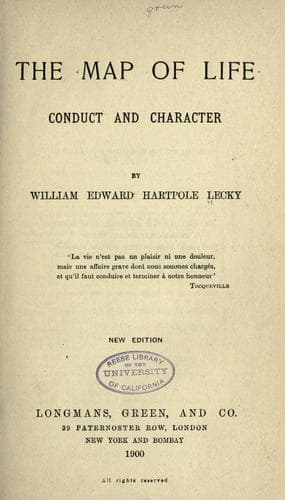
The Map of Life: Conduct and CharacterLecky, William Edward Hartpole
Philosophy
The Map of Life: Conduct and Character
Lecky, William Edward Hartpole
Character; Conduct of life
interest in the theological distinctions which once were deemed
supremely important and all strong belief in great parts of dogmatic
systems, and such men naturally prefer services which by music and
ornament gratify their tastes and exercise a soothing or stimulating
influence over the imagination.
The extreme High Church party has, however, other elements of
attraction. Much of its power is due to the new springs of real
spiritual life and the new forms of real usefulness and charity that
grew out of its highly developed sacerdotal system and out of the
semi-monastic confraternities which at once foster and encourage and
organise an active zeal. The power of the party in acting not only on
the cultivated classes but also on the poor is very manifest, and it has
done much to give the Church of England a democratic character which in
past generations it did not possess, and which in the conditions of
modern life is supremely important. The multiplication not only of
religious services but of communicants, and the great increase in the
interest taken in Church life in quarters where the Ritualist party
prevail, cannot reasonably be questioned. Its highly ornate services
draw many into the churches who never entered them before, and they are
often combined with a familiar and at the same time impassioned style of
preaching, something like that of a Franciscan friar or a Methodist
preacher, which is excellently fitted to act upon the ignorant. If its
clergy have been distinguished for their insubordination to their
bishops, if they have displayed in no dubious manner a keen desire to
aggrandise their own position and authority, it is also but just to add
that they have been prominent for the zeal and self-sacrifice with which
they have multiplied services, created confraternities, and penetrated
into the worst and most obscure haunts of poverty and vice.
The result, however, of all this is that the conflicting tendencies
which have always been present in the Church have been greatly deepened.
There are to be found within it men whose opinions can hardly be
distinguished from simple Deism or Unitarianism, and men who abjure the
name of Protestant and are only divided by the thinnest of partitions
from the Roman Church. And this diversity exists in a Church which is
held together by articles and formularies of the sixteenth century.
Public-domain text, read in full here on John Shaqi.
Reviews
Reviews
No reviews yet
Be the first to share your thoughts on this work.
Elsewhere in the archive
Join the Discussion
Join the discussion
Sign in to leave a comment or review.
Sign InorCreate an account