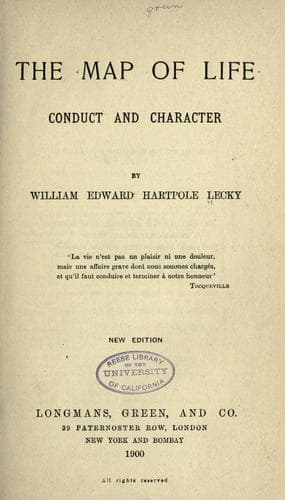
The Map of Life: Conduct and CharacterLecky, William Edward Hartpole
Philosophy
The Map of Life: Conduct and Character
Lecky, William Edward Hartpole
Character; Conduct of life
It might, perhaps, _a priori_ have been imagined that a Church with so
much diversity of opinion and of spirit was an enfeebled and
disintegrated Church, but no candid man will attribute such a character
to the Church of England. All the signs of corporate vitality are
abundantly displayed, and it is impossible to deny that it is playing an
active, powerful, and most useful part in English life. Looking at it
first of all from the intellectual side, it is plain how large a
proportion of the best intellect of the country is contented, not only
to live within it, but to take an active part in its ministrations.
Compare the amount of higher literature which proceeds from clergymen of
the Established Church with the amount which proceeds from the vastly
greater body of Catholic priests scattered over the world; compare the
place which the English clergy, or laymen deeply imbued with the
teaching of the Church, hold in English literature with the place which
Catholic priests, or sincere Catholic laymen, hold in the literature of
France,--and the contrast will appear sufficiently evident. There is
hardly a branch of serious English literature in which Anglican clergy
are not conspicuous. There is nothing in a false and superstitious creed
incompatible with some forms of literature. It may easily ally itself
with the genius of a poet or with great beauty of style either hortatory
or narrative. But in the Church of England literary achievement is
certainly not restricted to these forms. In the fields of physical
science, in the fields of moral philosophy, metaphysics, social and even
political philosophy, and perhaps still more in the fields of history,
its clergy have won places in the foremost rank. It is notorious that a
large proportion of the most serious criticism, of the best periodical
writing in England, is the work of Anglican clergymen. No one, in
enumerating the leading historians of the present century, would omit
such names as Milman, Thirlwall and Merivale, in the generation which
has just passed away, or Creighton and Stubbs among contemporaries, and
these are only eminent examples of a kind of literature to which the
Church has very largely contributed. Their histories are not specially
conspicuous for beauty of style, and not only conspicuous for their
profound learning; they are marked to an eminent degree by judgment,
criticism, impartiality, a desire for truth, a skill in separating the
proved from the false or the merely probable. Compare them with the
chief histories that have been written by Catholic priests. In past ages
some of the greatest works of patient, lifelong industry in all literary
history were due to the Catholic priesthood, and especially to members
of the monastic orders; even in modern times they have produced some
works of great learning, of great dialectic skill, and of great beauty
of style; but with scarcely an exception these works bear upon them the
Public-domain text, read in full here on John Shaqi.
Reviews
Reviews
No reviews yet
Be the first to share your thoughts on this work.
Elsewhere in the archive
Join the Discussion
Join the discussion
Sign in to leave a comment or review.
Sign InorCreate an account