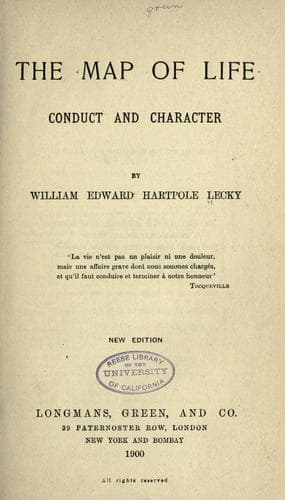
The Map of Life: Conduct and CharacterLecky, William Edward Hartpole
Philosophy
The Map of Life: Conduct and Character
Lecky, William Edward Hartpole
Character; Conduct of life
is also due to the extravagant glorification of athletic games.
If we compare the class of pleasures I have described with the taste for
reading and kindred intellectual pleasures, the superiority of the
latter is very manifest. To most young men, it is true, a game will
probably give at least as much pleasure as a book. Nor must we measure
the pleasure of reading altogether by the language of the genuine
scholar. It is not every one who could say, like Gibbon, that he would
not exchange his love of reading for all the wealth of the Indies. Very
many would agree with him; but Gibbon was a man with an intense natural
love of knowledge, and the weak health of his early life intensified
this predominant passion. But while the tastes which require physical
strength decline or pass with age, that for reading steadily grows. It
is illimitable in the vistas of pleasure it opens; it is one of the most
easily satisfied, one of the cheapest, one of the least dependent on
age, seasons, and the varying conditions of life. It cheers the invalid
through years of weakness and confinement; illuminates the dreary hours
of the sleepless night; stores the mind with pleasant thoughts, banishes
ennui, fills up the unoccupied interstices and enforced leisures of an
active life; makes men for a time at least forget their anxieties and
sorrows, and if it is judiciously managed it is one of the most powerful
means of training character and disciplining and elevating thought. It
is eminently a pleasure which is not only good in itself but enhances
many others. By extending the range of our knowledge, by enlarging our
powers of sympathy and appreciation, it adds incalculably to the
pleasures of society, to the pleasures of travel, to the pleasures of
art, to the interest we take in the vast variety of events which form
the great world-drama around us.
To acquire this taste in early youth is one of the best fruits of
education, and it is especially useful when the taste for reading
becomes a taste for knowledge, and when it is accompanied by some
specialisation and concentration and by some exercise of the powers of
observation. 'Many tastes and one hobby' is no bad ideal to be aimed at.
The boy who learns to collect and classify fossils, or flowers, or
insects, who has acquired a love for chemical experiments, who has begun
to form a taste for some particular kind or department of knowledge, has
laid the foundation of much happiness in life.
Public-domain text, read in full here on John Shaqi.
Reviews
Reviews
No reviews yet
Be the first to share your thoughts on this work.
Elsewhere in the archive
Join the Discussion
Join the discussion
Sign in to leave a comment or review.
Sign InorCreate an account